Your next guest is already searching, and the only question is whose name sits on the booking button.
Independent hotels now send 63.4% of their bookings through online travel agencies (OTAs), up two points in a single year, according to our State of Independent Hotels Report. That is commission, rate discounting, and a guest relationship that belongs to somebody else.
Hotel advertising is how you take it back. Done well, it puts your direct rate in front of high-intent travelers before the OTA listing loads, brings back the visitors who almost booked, and builds the brand awareness that makes guests search for you by name next time.
You don’t need a big team or a chain-sized budget to do it. You need the right channels in the right order, a clear message, and numbers you can trust.
Key takeaways
- OTAs accounted for 63.4% of independent hotel bookings in 2025, with cancellation rates more than double direct bookings
- A full-funnel hotel advertising strategy combines awareness channels (PMax, social media, video), consideration channels (metasearch, Google Hotel Ads), and re-engagement channels (retargeting, email) to reach potential guests at every stage.
- Direct bookings generate up to 60% more revenue per booking than OTA reservations.
- The most effective hotel advertising is audience-specific
- Connecting your advertising to your booking engine and PMS data gives you the real-time visibility to optimize campaigns and measure ROI accurately.
What is hotel advertising?
Hotel advertising is the paid side of hotel marketing: campaigns you fund to promote your property, reach the right travelers, and drive direct bookings. It spans Google Hotel Ads and other metasearch advertising, social media advertising, video ads, display ads, retargeting, and offline formats like print ads and direct mail.
It sits alongside the organic hotel marketing strategies you already run, such as search engine optimization (SEO), email marketing, and reviews. The difference is that you pay for reach, which buys you speed and control over who sees your message and when. The strongest programs use both: paid channels fill demand now while organic work builds the base that keeps paying.
Where travelers start has shifted across the hospitality industry. SiteMinder’s Changing Traveller Report found that 26% of travelers now begin their hotel research on an OTA, ahead of the 21% who start with a search engine. The same report found that 18% of travelers who start on an OTA go on to book directly with the hotel. That second number is your opening: advertising that meets travelers while they compare is how you turn OTA research into a direct reservation.
Why hotel advertising matters more than ever
The cost of OTA reliance goes beyond commission. OTA channels discount rates to attract clicks and promote your whole comp set on the same page. Cancellations add volatility too: in 2025, 21.8% of OTA bookings were canceled compared with 10.6% of direct bookings, roughly double.
Here is what a strong hotel advertising strategy does for you.
Builds brand awareness
Travelers research over days or weeks, so consistent visibility across channels keeps your property in the running from first inspiration to final click.
Drives direct bookings
Every commission-free reservation is margin you keep. Direct guests also land in your CRM and on your email list, which is where repeat stays come from.
Reaches the right audience
Targeting lets you speak to the exact guest you want, whether that is business travelers, couples on a weekend escape, or families planning a summer trip.
Communicates your unique selling proposition
On a metasearch results page, guests compare dozens of properties side by side. Advertising is your chance to state your unique selling points clearly before they click the listing next to yours.
Recaptures lost revenue
Most website visitors leave without booking. Retargeting ads bring those high-intent visitors back to your booking engine instead of letting a competitor win them.
63.4% OTA booking rate.
This is globally. See OTA influence where you operate.
Hotel advertising channels that move the needle
Not every channel does the same job. Some help travelers discover you for the first time, while others capture demand when guests are actively comparing. The strongest programs cover the whole booking journey, starting at the top of the funnel and working down.
| Advertising channel | Stage of the guest journey | Best for |
| Social media advertising | Discovery | Inspiring travel demand and showing your brand personality |
| Video advertising | Inspiration | Bringing your property and atmosphere to life |
| Performance Max for Travel Goals (Hotel PMax) | Consideration | Capturing travel intent across the Google ecosystem |
| Google Hotel Ads and metasearch advertising | Comparison | Winning travelers who are actively comparing rates |
| Retargeting and display ads | Conversion | Recovering bookings that did not convert the first time |
| OTA travel ads | Comparison | Visibility on OTA search results, with commission still applying |
| Email marketing and loyalty programs | Retention | Turning past guests into repeat direct bookers |
| Print advertising and direct mail | Local and offline | Reaching affluent, local, or hard-to-target audiences |
Travelers use Instagram and TikTok to plan trips, which makes social media advertising a strong discovery channel. Social media ads reach people in a browsing mindset, so visual quality and creative matter more here than anywhere else.
- Facebook and Instagram offer the deepest targeting, with custom audiences, lookalike audiences, interest targeting, and geographic filters
- TikTok works as a discovery channel for younger travelers, and TikTok GO lets users book hotels in the app, but bookings run through OTA partners like Booking.com and Expedia, so they are not direct bookings
- Influencer partnerships extend reach without a big ad budget, and the content can double as user-generated content for your own ads
Pine Tree Hotel in Idyllwild, California, says 98% of its bookings come direct, and its team treats creators as a core part of the funnel. But relevance beats follower count, Tim Ensmann, Hotelier, Investor, Founder & Managing Partner of Boutique Hotel Fund, shared on The Turndown:
Watch the full episode.
Tim Ensmann on the business case for doing hotels differently.
Run retargeting behind your social media campaigns to catch the people who engaged but didn’t book.
Video advertising
Video shows the light in the room, the sound of the place, and the feeling of arriving in a way copy cannot. Short-form video and YouTube pre-roll both work well for hotel advertising.
You don’t need a production budget. Guest footage, used with permission and edited thoughtfully, often feels more authentic than a polished brand film.
Display advertising and retargeting ads
Display advertising puts image ads in front of travelers across the web. On its own it can feel broad, but paired with retargeting it becomes one of the most efficient parts of your mix.
Most website visitors leave without booking, which is where retargeting campaigns earn their keep. When someone browses rooms or reaches your booking engine without converting, retargeting ads follow them with display ads that remind them of your property and give them a reason to return. Click-through rates tend to beat cold display because the audience is already warm.
The best retargeting ads have a clear call to action, a reason to act now, and imagery tied to what the guest viewed. If they looked at your suites, show them the suite.
Metasearch engines like Google Hotels, Trivago, and Tripadvisor are where travelers compare rates before they book. If your direct rate isn’t showing next to the OTAs, you’re invisible at the most important moment in the journey.
Metasearch advertising puts your direct booking link front and center, marked as the official site, right where travelers are comparing prices. You compete on rate and visibility instead of commission margin.
Rate parity matters here. Your booking engine needs to match or beat OTA rates, otherwise you’re paying for clicks that convert on someone else’s platform.
Don’t sleep on metasearch.
See how to turn metasearch into a simple, high-impact growth channel.
Hotel PMax runs across Google’s whole ecosystem: Search, Display, YouTube, Gmail, and Maps. Where metasearch captures travelers already comparing hotels, PMax reaches potential guests earlier, while they are still dreaming about the trip.
The campaign uses AI to adjust bidding and creative delivery in real time. In Cloudbeds, it is guided by audience signals built from your own reservation data, so Google learns what your best guests look like. For a boutique team without a marketing department, that means you set the budget, voice, and creative, and the campaign handles targeting.
OTA ads and travel ads
OTAs will always be part of the picture, and some properties choose to pay for placement inside them. Cloudbeds OTA Ads lets you create, fund, and manage travel ads and sponsored listings on OTA search results from the same platform you use to run your property, so there are fewer extranets and logins to juggle.
Commission still applies to bookings made through OTAs, so treat this as a visibility tool and measure it against your direct channels.
Print advertising and direct mail
Print advertising still earns a place for luxury hotels targeting affluent readers and for boutique properties in tourism-heavy destinations. Direct mail works for past guests too: a postcard with a returning-guest offer can cut through a crowded inbox. Print rarely tracks cleanly, so give each placement its own booking code or landing page and judge it on booked revenue.
What it looks like when the stack works
The properties getting the best results aren’t picking one channel, but are layering them.
Data from the Cloudbeds Compass Spring Release, drawn from more than a thousand active campaigns in early 2026, found that properties using metasearch, retargeting, and Hotel PMax together saw 242% more bookings from their digital marketing program than those running metasearch alone. Adding retargeting to metasearch lifted net sales by 205% over metasearch by itself. The advice from the team: stack, don’t skip.
One detail matters as much as the mix. Campaigns need to stay funded:
Every time your campaign stops and starts because it stopped funding it, it essentially resets that learning period.
When a regulatory issue in spring 2026 temporarily blocked the Pembroke Inn from certain OTAs, the 52-room Toronto hotel added metasearch ads, retargeting, and Hotel PMax on top of its Cloudbeds website and booking engine.
Over six months, Cloudbeds Digital Marketing attributed about $263,000 in booked revenue to those campaigns, with ROI of 11x on metasearch, 7.74x on retargeting, and 7.24x on Hotel PMax. By August the hotel was near full again, with an estimated 80 to 90% of bookings coming direct.
How to build a hotel advertising strategy in five steps
A hotel advertising strategy doesn’t need to be complicated, but it does need to be deliberate.
- Set one clear goal, such as direct booking share, booked revenue, or occupancy rates for a specific season
- Define your unique selling proposition by listing what only your property can say, then check how your comp set advertises to find the gap
- Match channels to funnel stage, starting with metasearch where intent is highest, then layering retargeting, Hotel PMax, and social
- Fix the landing experience before you spend, because your hotel website and booking engine must match the promise of the ad
- Measure monthly, move budget toward campaigns producing booked revenue, and cut what isn’t
How to measure return on ad spend
Return on ad spend (ROAS) is booked revenue divided by ad spend. A 10x ROAS means every dollar spent returned ten dollars in reservations. Unlike impressions or likes, it tells you whether the campaign paid for itself.
| Metric | What it tells you |
| Return on ad spend | Booked revenue per dollar of ad spend |
| Booked revenue and reservations by source | Which channels (paid, organic, booking links) drive real bookings |
| Click-through rates | Whether your creative and offer earn attention |
| Cost per booking | How efficiently each channel converts |
| Direct booking share | Whether your mix is moving away from OTAs |
| Rate parity | Whether your direct price wins the comparison |
Remember that advertising’s effect extends beyond last click. A guest might see an ad, keep researching, and book on your website days later, which is why booked revenue by source gives a more honest picture than clicks alone.
Advertising in the age of AI search
Search is moving into conversations. On August 27, 2026, Google began letting US travelers find, compare, and book hotels entirely inside AI Mode. The launch partners were the largest OTAs and hotel chains, including Booking.com, Expedia, Hilton, Marriott, and IHG.
The State of Independent Hotels flags the same shift: traditional SEO still matters, but generative engine optimization (GEO), which means structuring your property information so AI systems can read it accurately, is becoming a must-have skill.
In practice, that means a hotel website with structured data, rates that never lose to the OTAs, and a smooth direct booking path, the same foundations that make paid campaigns convert.
25 hotel advertising examples worth studying
Here are some hotel advertising ideas to help inspire your strategy:
Google Ads
1. Leverage local attractions & sights
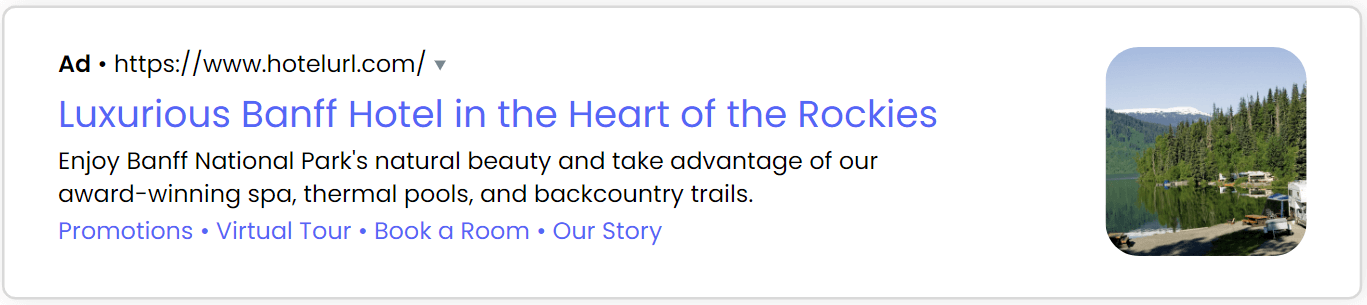
Target guests who are searching for hotels near local attractions and sights by highlighting the convenience of staying at your property. For example, the ad below was created to target website visitors looking for a ‘nice hotel close to Banff National Park’. This ad showcases its location along with relevant activities like hiking trails and thermal pools.
2. Have an event coming up in your area? Take advantage of it
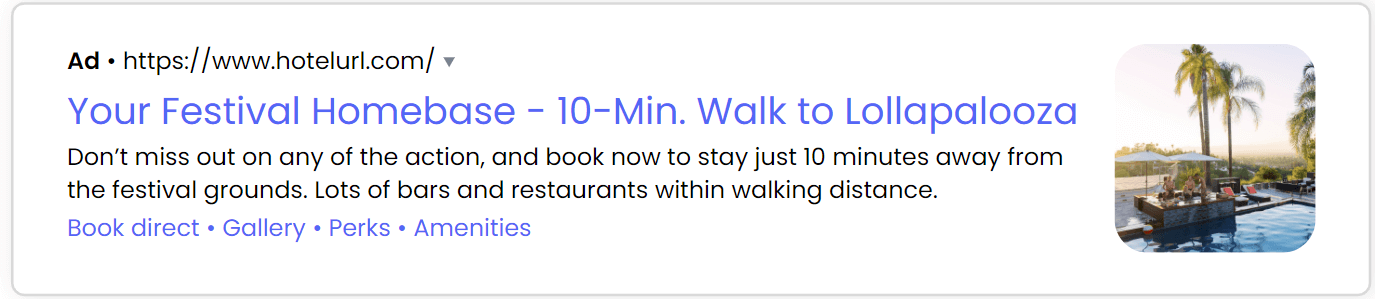
Does your city host large events, festivals, or conferences that bring in travelers from around the world? As part of your advertising strategy, bid on keywords like “hotels close to [event name]” to capitalize on this traffic. Many travelers buy tickets for big events and festivals a year out and look to book accommodations as soon as possible, so stay on top of your local event calendar.
3. Communicate your value
Ensure that you communicate your property’s unique value proposition in your digital advertisements. Differentiate yourself from the competition by clearly stating what makes your property appealing. Do you deliver the best price? Award-winning dining options? Pet-friendly accommodations? Prioritize keywords that potential customers will be looking for.
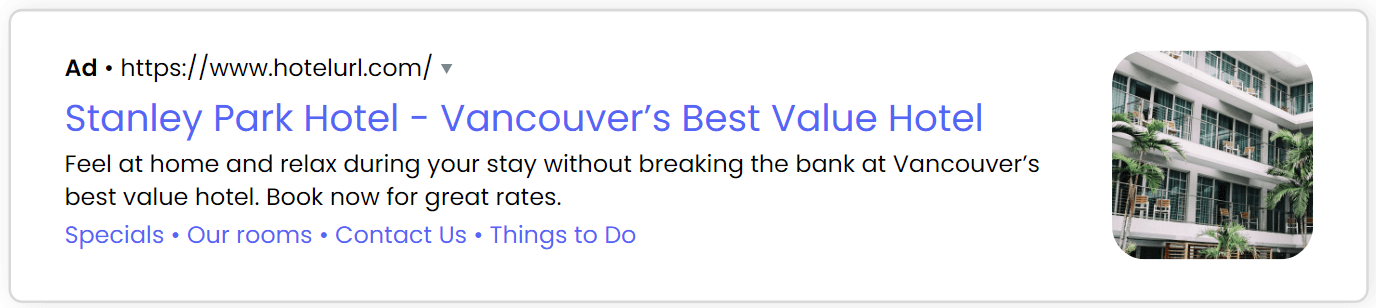
4. Make it clear what guests can expect from your hotel
Based on your target personas, develop ad copy that will resonate with each group. For example, Sunny Lodge gives a nod to the surf subculture of Southern California and has a link dedicated to surf spots, which solidifies its expertise in that area. This ad also details important hotel amenities like contactless check-in, free wifi, and beach access.
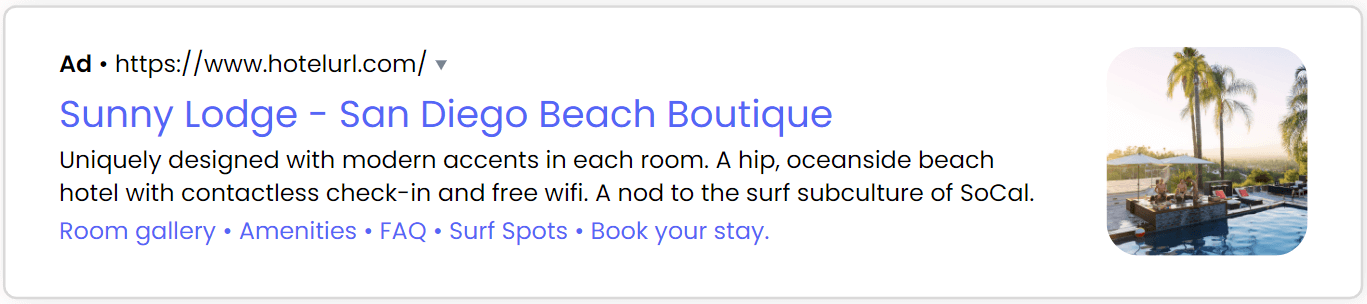
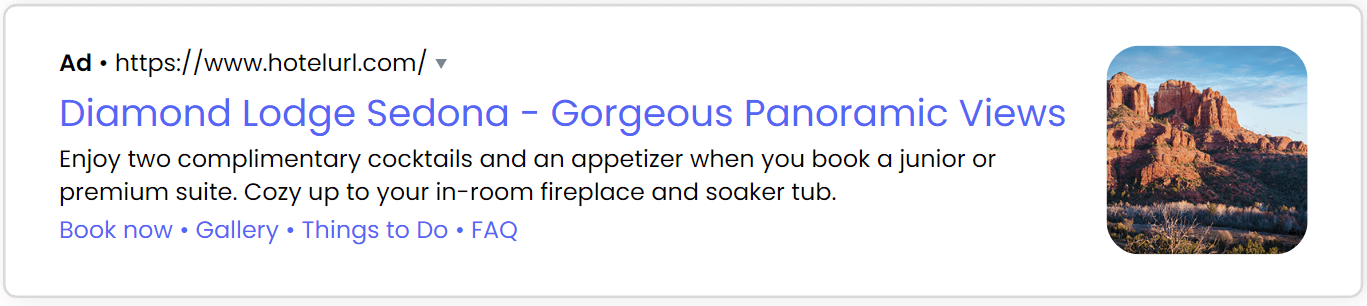
Try out different offers in your ad copy to entice travelers to book direct such as complimentary welcome drinks or a free meal. Test different packages to maximize revenue, like the example below, where a guest must book a suite in order to get the complimentary cocktail and meal.
Video ads
6. The Social Hub
The Social Hub keeps it fun in its ad and uniquely shares its point of view. This ad does a great job of showcasing the hotel’s brand and highlights the vibe travelers can expect from staying with them.
7. Meliá Hotels
The Meliá Hotels ad is short and sweet at just 20 seconds but manages to convey a luxurious and relaxing experience using imagery and sound. This ad is a great example of how a video doesn’t have to be complex to be impactful.
8. Marriott Bonvoy
Marriott Bonvoy’s ad for its Autograph Collection does a great job of using imagery to showcase its creative hotel offerings around the world, incorporating the tagline “Where can we take you?”
9. Skylodge Adventure Suites
Does your property offer a super unique lodging experience? Skylodge Adventure Suites lets guests spend a night in a hanging pod 2900 meters above sea and proudly showcases this unique selling proposition in its hotel ads.
10. Canalta Lodge
The virtual reality industry is expected to grow at a compound annual growth rate (CAGR) of 27.5% from 2023 to 2030, providing a fantastic opportunity for lodging businesses to showcase their property. The Canalta Lodge has implemented VR as an interactive experience for potential guests to explore their amenities and rooms before booking.
View Canalta’s VR experience.
Social media ads
11. Take advantage of local events
Create custom audiences based on location and interests and use local events to promote your hotel. For example, if you have a beer or food festival happening in your city, target Facebook users from surrounding areas to spend a weekend out of town enjoying a fun event.
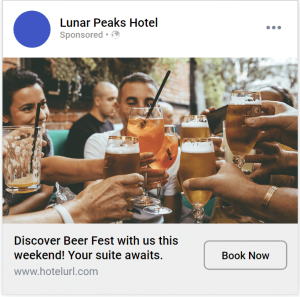
12. Use ads to increase your follower count!
You don’t always have to use ads to drive bookings. Try using awareness ads to get people to follow your page. From here, you can use organic social media posts to nurture travelers and stay top of mind until they’re ready to book.
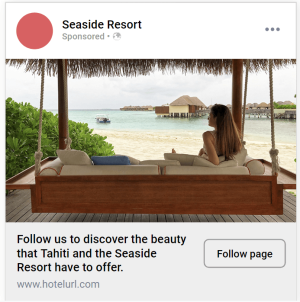
13. Use high-quality images of your hotel
Use social media ads to showcase the beauty of your property! Highlight what guests can expect by booking a stay at your property and make it so that they can’t scroll by without taking a closer look.
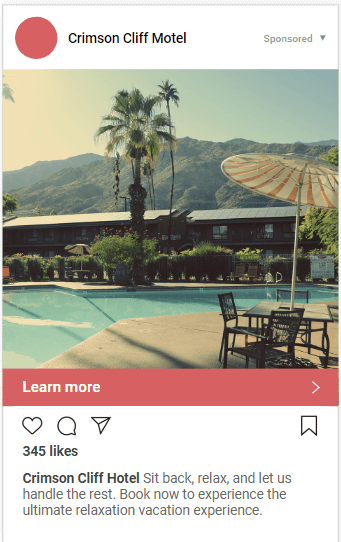
14. Use eye-catching imagery
On Instagram, focus on using eye-catching imagery to capture users’ attention and inspire their future travel plans. Your ads should portray an experience that travelers can expect by booking with you and make your hotel a bucket list destination.
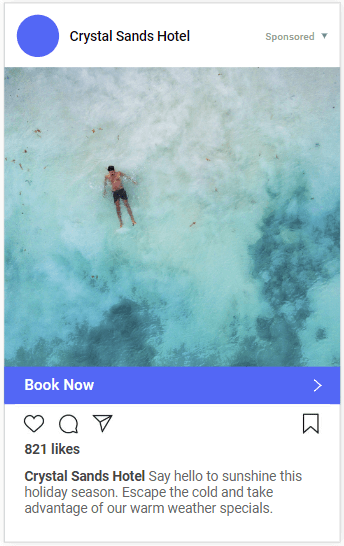
15. Get creative
Use fun challenges and creative tactics to increase brand awareness across social media. Selina, for example, took advantage of the Wes Anderson TikTok trend to promote its property in St Kilda, Melbourne.
Retargeting ads
16. Entice travelers back with an offer
Use retargeting ads to promote special offers and loyalty programs to get past visitors to return to your website and convert.
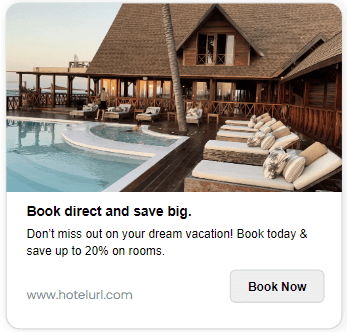
17. Create a sense of urgency
Use language in your retargeting ads to create a sense of urgency to book. Since users have visited your website and are clearly planning a trip, urgency can help drive them to their final action more quickly.
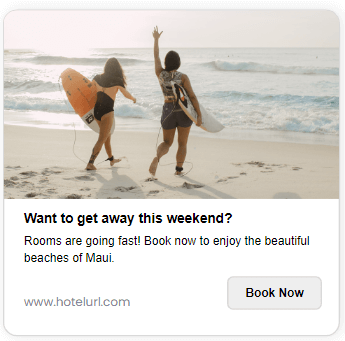
18. Include a timeframe to book
Don’t leave your ad open-ended. Instead, use relevant time-frames to encourage travelers to visit your website and make a hotel booking.

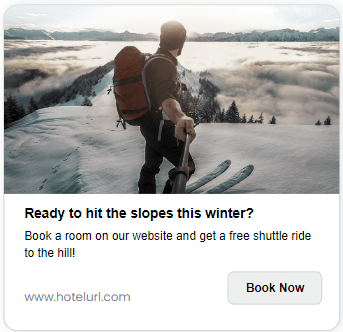
19. Target specific personas in your ad
If your hotel attracts a certain persona (for example, skiers), entice them to book with relevant imagery and relevant ad copy.
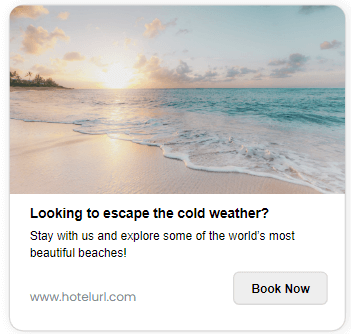
20. Use relevant copy based on location
Take advantage of your hotel or hotel group’s location (or capitalize on where your audience lives) and use ad copy and imagery to convince travelers to book. For example, if you have a hotel close to the beach, target travelers in colder climates by showcasing how they can escape the winter blues.
Print ads
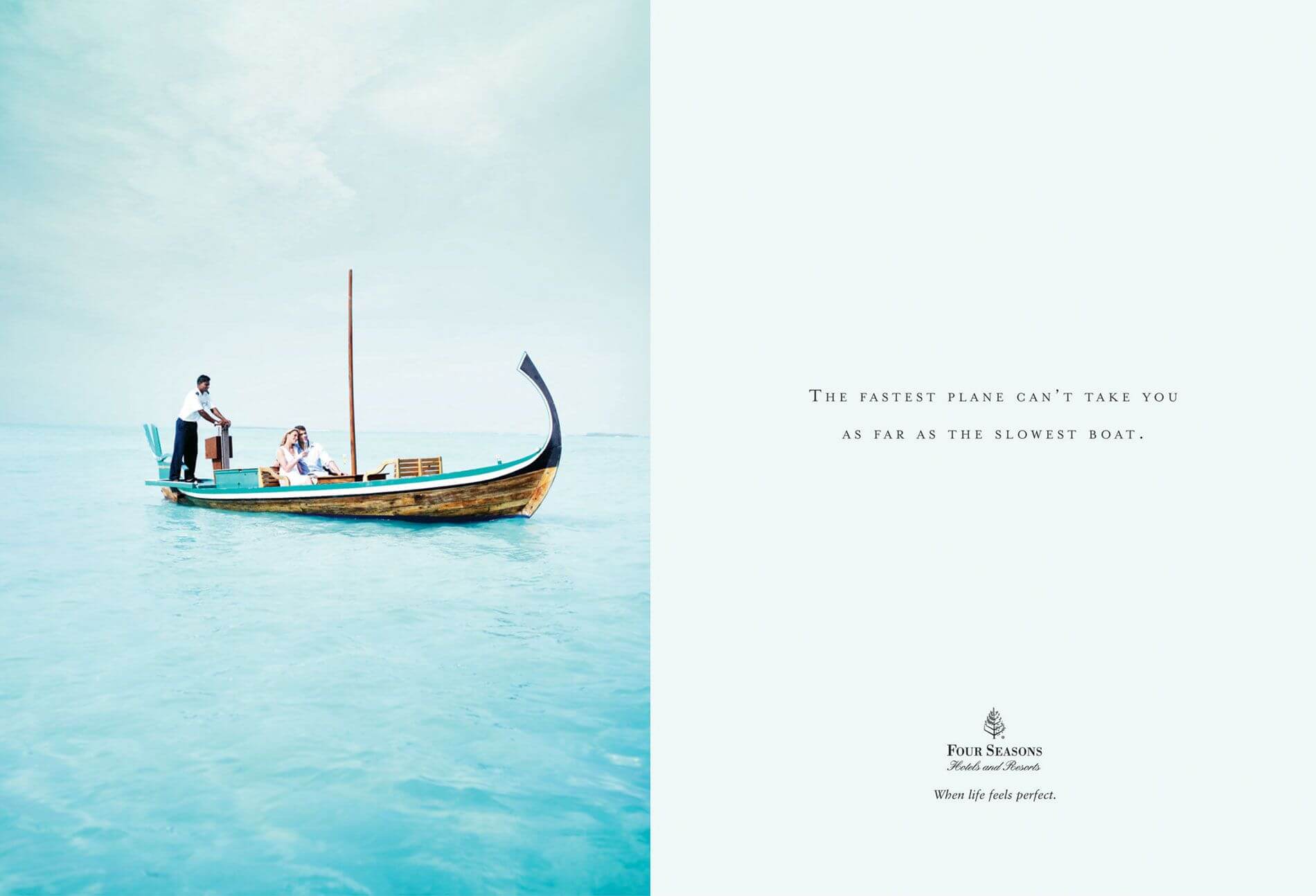
21. Four Seasons
The Four Seasons ad expertly resonates with its luxurious clientele using simple imagery. The agency responsible for this ad says, “If we are speaking to a time-starved audience where every second of the day is scheduled, our minimalist and transporting approach instantly became a surrogate for the space and openness of the Four Seasons experience.”
22. Rove la Mere
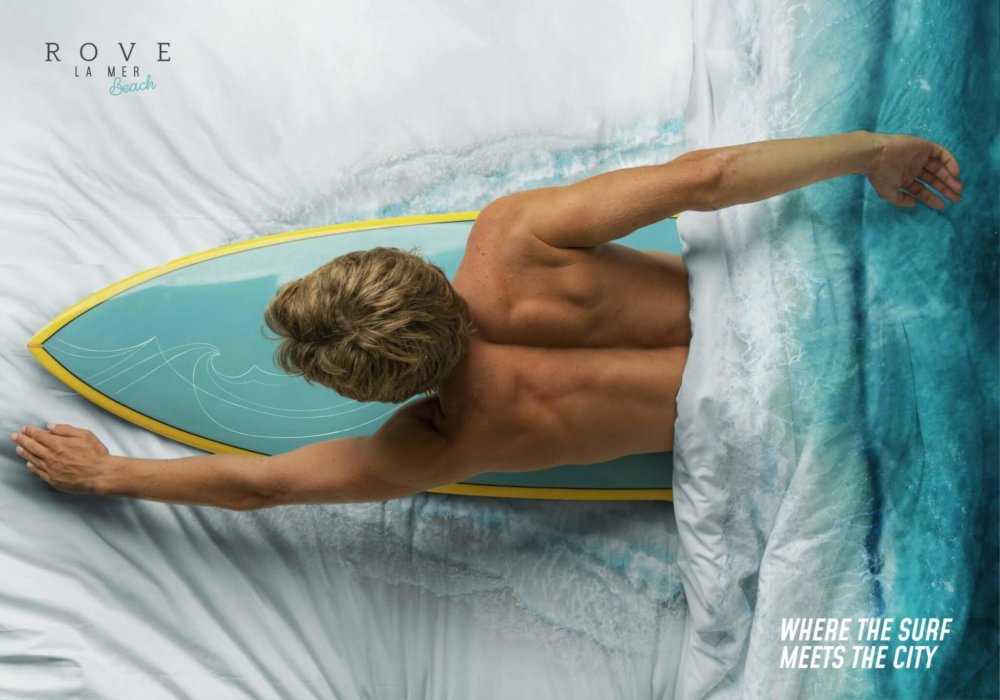
Rove la Mere’s ad is eye-catching and purposeful. It does a great job of appealing to its target audience with its clear, concise message of ‘Where the Surf Meets the City’ and accompanying imagery.
23. Meliá Hotels
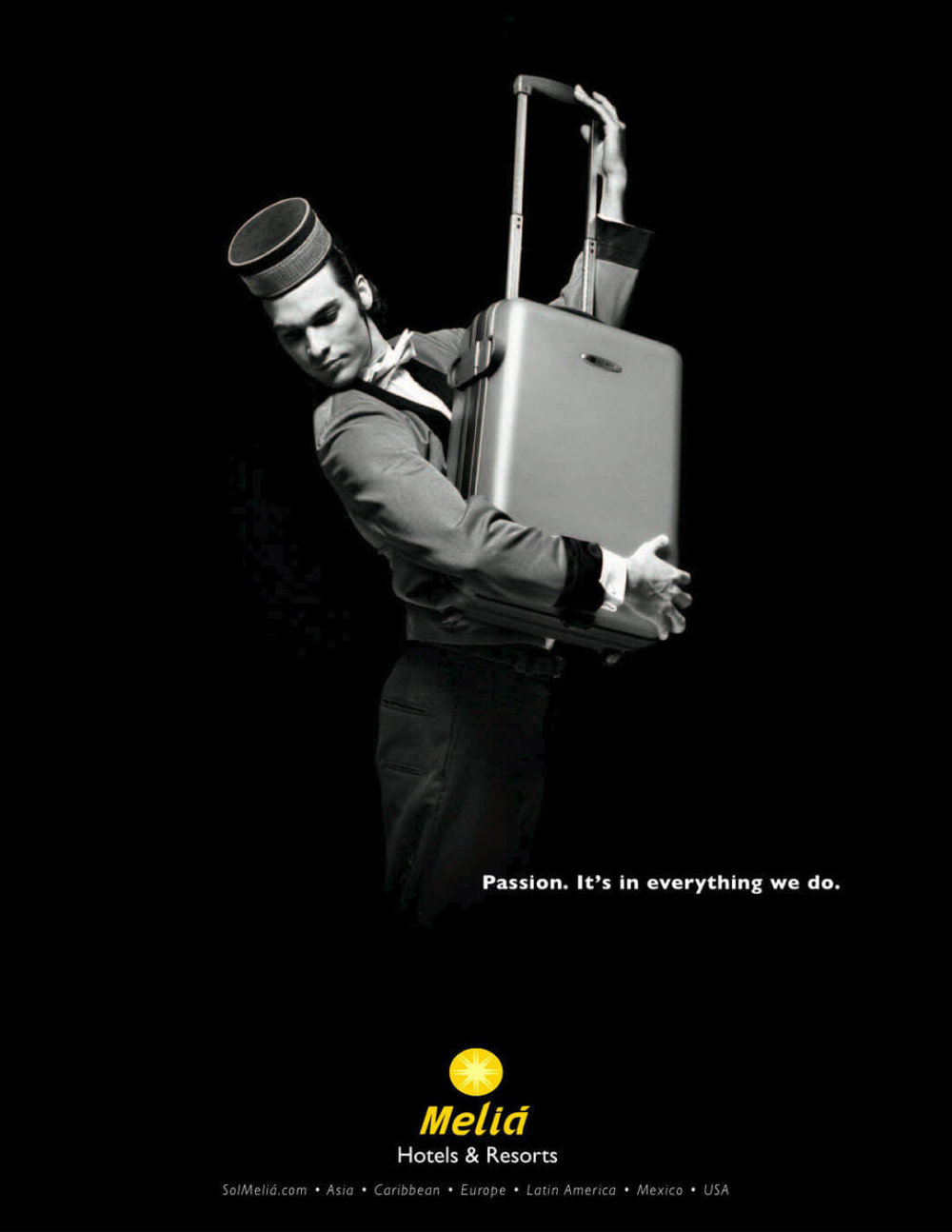
The Meliá Hotels does it again, but this time with their print ad. They’ve mastered telling a story with few words, relying on creative imagery to draw viewers in.
24. Tokyo Palace Hotel
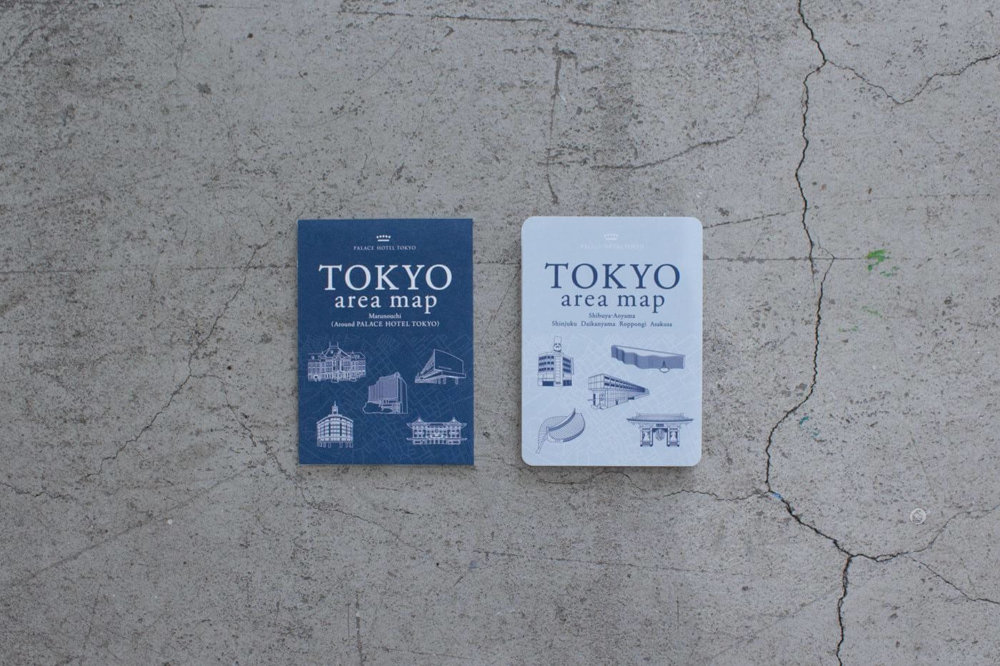
Don’t feel constrained to classic print ads in newspapers or magazines! Tokyo Palace Hotel steps outside the box with its print ad in the form of a map. Not only is this an interesting concept, but it’s also practical for visitors — even if they aren’t staying at the Tokyo Palace this trip, they’ll have a reminder if they’re ever to revisit Tokyo.
25. Twenty Sundays
Twenty Sundays is a boutique hotel that targets families with young children. They creatively convey their message with their print advertising campaigns with slogans such as ‘Wild Things Need Wild Places’ and ‘Luxury Hotel for Parents of the Unruly.’

5 tips for creating hotel ads that actually work
No matter what hotel market strategy you choose, here are a few tips to help you create ads that work.
1. Test continuously
A “set it and forget it” hotel advertising strategy underperforms. Test headlines, imagery, offers, and audiences, then put more budget behind what works.
2. Match your budget to the season
Spend more when demand peaks, and save promotions for shoulder season or for when forecast occupancy rates dip. Keep campaigns funded so the algorithms keep learning.
3. Use user-generated content
Real guest photos, reviews, and stories tend to feel more trustworthy than brand-produced creative. Make it easy for happy guests to share, and respond to reviews on Google and Tripadvisor because they shape how you appear in results.
4. Don’t forget the landing page
A great ad that sends traffic to a slow or confusing hotel website wastes every click. Your booking engine has to deliver on what the ad promised.
5. Connect your advertising to your data
When your booking engine, channel manager, and marketing platform share the same data layer, you can see which campaigns drive revenue and optimize accordingly.
Mistakes that drain budgets
- Sending ad traffic to a rate that loses to the OTAs
- Pausing campaigns during slow weeks, which resets the learning period
- Measuring clicks and impressions instead of booked revenue
- Skipping your own brand name in search, where OTAs will happily bid
How Cloudbeds Digital Marketing brings it together
Running a full-funnel hotel advertising program across several platforms is a lot to manage, especially for properties without a dedicated marketing team.
Cloudbeds Digital Marketing brings metasearch advertising, Hotel PMax, retargeting, OTA Ads, and reputation management into one place. It is natively integrated with the Cloudbeds PMS and booking engine, which sit on the same data layer. That matters because your rates, availability, and ad performance live in one system, so campaigns reflect current inventory with no manual updates and no mismatched pricing.
- Set your own budget and fund campaigns with ad credits, so you control spend and visibility
- AI builds retargeting ads in seconds and refreshes the copy weekly
- Hotel PMax campaigns use audience signals from your reservation data
- Rate parity tools show where your direct price stands against OTAs
- The performance dashboard inside the PMS tracks booked revenue and reservations by source (ads, organic, and booking links)
Pair it with Cloudbeds RMS, so the rates you advertise are the rates the market will pay. Add Guest Marketing to turn those new direct guests into repeat ones.
Own the booking.
Join thousands of hoteliers who are driving more direct bookings with Cloudbeds.