
Group pricing is where revenue management gets complicated. Sales is under pressure to fill rooms, while revenue teams are under pressure to protect ADR and make sure every block of rooms is worth what it costs.
When these two functions aren’t aligned, hotels either leave money on the table by taking groups they shouldn’t, or lose deals they should have won because pricing parameters weren’t defined in advance.
The goal of a group pricing strategy isn’t to say yes or no to group business, but to make that decision consistently, quickly, and based on the right data. This guide walks through how to do that.
Why group business belongs in your revenue mix
Before getting into pricing mechanics, it helps to understand why group bookings have a place in any hotel’s revenue management strategy at all, because the argument isn’t just “they fill rooms.”
Demand is growing. According to the Global Business Travel Association, global business travel spending is projected to surpass $2 trillion by 2029. A reminder that meetings, corporate events, and contracted group business are a long-term part of the revenue mix.
As Beth James, Product Solutions Manager at Cloudbeds and experienced revenue manager, explains, there are three reasons groups earn their place.
1. Groups secure base occupancy in advance
Groups have longer booking windows than transient demand. That means revenue certainty earlier in the planning cycle and a foundation from which to build transient pricing strategy.
As a revenue manager, you want to try and lock in occupancy base far in advance. Groups are one of the easiest ways to do that, especially when you include some form of attrition clauses in the contract.
A predictable room block on the books gives revenue managers something to price around. You know what’s committed, so you can optimize the rest.
2. Groups offset low transient demand
Transient business tends to carry higher ADR, but you can’t rely on it to fill need periods. Groups are one of the most reliable tools for managing seasonality and protecting occupancy during historically soft dates. A group that fills 60 rooms on a Tuesday in February is worth significantly more to total revenue than a transient booking you might never have captured at all.
3. Groups drive higher total revenue
Rooms are the starting point, not the ceiling. When you factor in F&B minimums, AV rentals, meeting space, ancillary spend, and ad-hoc purchases on property, groups consistently generate more total revenue per stay than transient guests. TRevPAR — total revenue per available room — is the metric that captures this. A group booking that looks modest on RevPAR alone may look very different when you include everything the group actually spends.
With groups, you have to look at the overall revenue potential and the impact on your higher-rated business.
Understanding group rate types
All group rates involve a discount from your standard pricing. How you calculate that discount depends on the type of group you’re working with.
Corporate rates
Corporate negotiated accounts operate differently from traditional group business. Rates are either set for specific MICE events — meetings, incentives, conferences, and exhibitions — or established on a contractual basis as a room allotment a corporate account can draw on throughout the duration of an agreement.
For MICE groups, guests arrive and depart on fixed dates, like any other group, but they often require function space and full F&B service, which increases pricing complexity and total revenue opportunity. For contracted allotments, a safeguard clause is typically included to protect the hotel if the company doesn’t reach the agreed room volume.
The base for corporate rate negotiation is typically the standard fixed rate or the highest rate for a given room category. Discounts usually range from 10–20%, depending on volume, seasonality, and how much flexibility the property has in the period being contracted.
Unlike hotel room rates for transient guests, which fluctuate daily with demand, corporate negotiated rates are typically fixed for a contract period, which is why rate parity and revenue parameter enforcement matter so much.
Traditional group rates
Traditional groups. including tour operators, travel agencies, and SMERF groups (Social, Military, Educational, Religious, and Fraternal), typically negotiate off the BAR rate: the best available rate at the time of inquiry, which fluctuates with your dynamic pricing strategy.
Because these groups tend to book closer to arrival and are less likely to generate repeat business, rates are generally higher than with corporate accounts. The key risk to manage is agreeing to a static rate that makes sense at the time of negotiation but looks damaging when demand shifts.
When you get yourself into a static rate, you could potentially hurt your revenue, for example, if you agree on a $120 rate for a period when you have 80% occupancy and the BAR rate you could get from transient business is $350.
This is exactly the scenario that displacement analysis is designed to prevent.
How to evaluate whether a group is worth taking: The displacement framework
The most important question in hotel group pricing isn’t “What rate should we offer?” It’s “Should we take this group at all, given what we’d be giving up?”
That’s what displacement analysis calculates: the minimum group rate required to compensate for the loss of transient revenue. If the group’s total value — rooms plus ancillary spend — clears that threshold, you take it. If it doesn’t, you either reprice or decline.
The three inputs that should drive this decision:
1. Demand forecasting for the period
What does historical occupancy data tell you about transient demand on these dates? What’s the current booking pace? Is this a period where you can realistically fill the house at full rate without the group? If yes, taking a discounted block actively hurts your RevPAR. If not, the group may be the most profitable use of that inventory.
2. Total revenue potential of the group
Don’t evaluate group business on room revenue alone. A company meeting with full-service F&B, AV equipment, and breakout meeting space may have a room rate that looks modest but a total package that far exceeds what a comparable number of transient guests would spend.
3. Level of operational complexity
More services mean higher total revenue potential but also higher operational costs and more staff attention.
More services command higher rates, but also increase operational costs and require more attention from hotel staff.
7 strategies to maximize group revenue
Once you’ve established your framework for evaluating group business, these strategies help you execute it consistently.
1. Align revenue management and sales before the proposal goes out
The most common group pricing mistake is a sales team making rate decisions without revenue management input.
Sales should not be making rate decisions without consulting revenue management, but revenue management should provide sales with parameters — such as the minimum rate — to make better decisions.
Establish a clear pricing parameter process: revenue management sets the floor and communicates which dates are high-demand (where groups should be priced at or above transient rate) and which are soft (where more aggressive group pricing makes sense). Sales works within those parameters. Both teams move faster, and the property doesn’t leave revenue on the table in either direction.
2. Never take groups over peak demand periods at a discount
Even though this is yield management 101, it’s violated constantly.
If I was the revenue manager of a hotel in Times Square, I would never take a group over New Year’s Eve because I would know that I could sell to transient at extremely high rates.
During periods of historically high transient demand, group business should be priced at transient rate or higher to justify displacing individual bookings. If a group won’t accept that rate, the answer is no, or defer them to low-demand dates where the math works in everyone’s favor.
3. Use attrition clauses to protect against cancellation risk
A group that fills 80 rooms and then cancels two weeks out costs you the transient business you closed out to hold their block. Attrition clauses define the minimum percentage of rooms a group must use, with a financial penalty if they fall short.
Include these in every group contract. Define the release timeline —how far in advance rooms can be dropped without penalty — so you have enough lead time to reopen inventory to the broader market.
4. Use block releases as your last line of defense
A block release clause establishes that any rooms not booked by the group by a specified date, typically 7–14 days before arrival, automatically return to general availability at the BAR rate.
The block release is the best failsafe clause, especially for larger properties in major destinations — you can anticipate a certain percentage of cancellations every night. With that expectation in mind, a release clause allows you to ebb and flow and oversell your property to certain extents.
5. Use LRA and NLRA strategically for corporate accounts
For contracted corporate accounts, the LRA/NLRA distinction is a meaningful negotiation lever.
LRA (last room availability) guarantees the corporate client can book at their negotiated rate regardless of occupancy levels. This is valuable to the client for consistent availability and consistent pricing, but it limits the hotel’s ability to yield up in high-demand periods.
NLRA (non-last room availability) allows the hotel to close out the contracted rate when occupancy hits a defined threshold, requiring the corporate client to book at BAR if they want availability. This protects revenue during peak periods but may deter clients who need guaranteed access.
The right choice depends on the account volume and the demand profile of the dates most likely to be booked. High-volume, year-round corporate accounts are usually worth the LRA commitment. Accounts concentrated in peak periods warrant a closer look.
6. Leverage benchmark data to price with market context
Group pricing should be a component of your broader hotel pricing strategy, and be informed by the same market intelligence you use to set transient rates. Knowing what comparable properties in your market are charging for similar group business is the difference between confident negotiation and guesswork.
STR’s segmentation reporting provides ADR data by group segment for major markets, a useful benchmark for understanding whether your group rates are competitive or leaving money on the table. In secondary markets where STR data is thinner, your own data becomes the primary reference: what did this same group pay last year? What did comparable groups pay for similar dates? What did those dates look like for transient demand?
This is where demand forecasting compounds over time. The more rigorously you track booking pace, historical occupancy, and group performance, the more precise your pricing parameters become. A demand calendar is the practical tool that translates this data into actionable pricing guidance for your sales team.
Many properties that have adopted a total revenue management mindset use the demand calendar as a shared planning document between revenue management and sales: it tells the sales team which dates are open to aggressive group pricing, which are protected for transient yield, and which fall in between.
7. Think in TRevPAR, not just RevPAR
RevPAR is the right metric for evaluating transient business. For group business, TRevPAR is more accurate, because it captures everything a group brings to the property beyond the room rate.
A group that books 50 rooms at $150/night and spends $8,000 on F&B and $3,000 on AV has a very different revenue profile than the room rate alone suggests. When revenue managers evaluate group business through a TRevPAR lens, the decisions get better, and the cases for taking lower-ADR groups with high ancillary spend become much easier to make.
Identifying your most profitable group segments
Not all group types are equally profitable and the right segment for your property depends on factors that are specific to your location, demand profile, and service capabilities.
Evaluate each group opportunity on three dimensions:
Seasonality alignment. Is this group booking soft dates you’d otherwise struggle to fill? Or are they asking for your peak weeks? The profitability of the same group at the same rate changes dramatically depending on when they’re booking.
Repeat potential. A recurring annual event that books the same block every year is worth more than a one-time booking at a comparable rate since the acquisition cost is lower, the operational knowledge is higher, and the forecasting reliability is better. Factor repeat probability into your pricing decisions.
Total revenue contribution. Which segments spend the most beyond the room? MICE groups with full F&B and meeting space requirements. Incentive groups that spend heavily on dining and activities. Corporate groups with contracted ancillary spend.
These are the segments where the gap between room revenue and total revenue is largest and where group pricing strategy can be most aggressive on room rate while still protecting overall profitability.
Technology that supports group pricing decisions
Revenue management systems (RMS) can be valuable tools for group pricing decisions, especially when it comes to demand forecasting and market benchmarking. They use historical data, booking pace analysis, and competitive rate intelligence to surface pricing recommendations.
But Beth offers an important caveat:
With groups, there are always external factors that come into play — things that can’t be predicted — and force you to manually adjust your pricing strategy.
While many systems incorporate helpful forward-looking demand indicators, group business still requires human judgment at the rate-setting stage, with technology handling the data-gathering and monitoring that would otherwise fall on the revenue manager’s plate.
Where technology makes a big practical difference for group pricing is in the operational execution: setting and enforcing release schedules, tracking what’s on the books by group, managing the quote-to-contract workflow, and giving revenue managers real-time visibility into room block utilization.
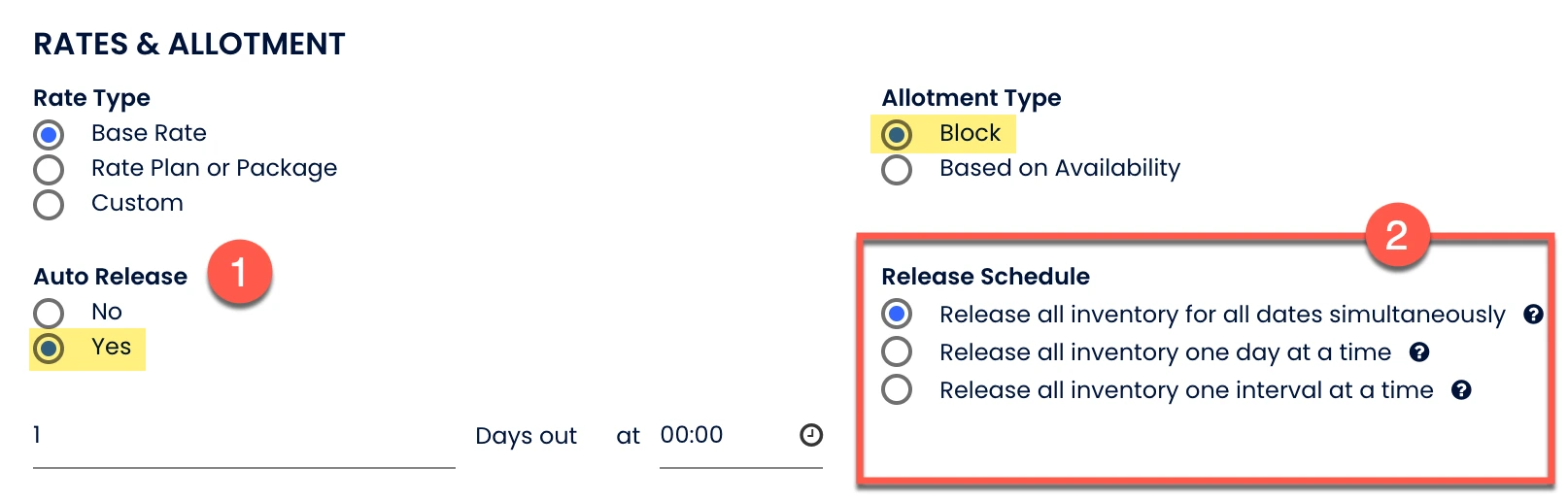
Cloudbeds supports this workflow across revenue management, sales, and operations. Revenue managers can set auto-releases that automatically return unsold group rooms to inventory on a predefined schedule. Sales teams can generate branded PDF quotes without leaving the PMS. And the quote pipeline view gives both teams a single source of truth on where every group opportunity stands.
Key takeaways
- Group pricing strategy is a revenue management and sales function
- The right question isn’t “what rate should we offer?” but “does this group’s total revenue potential clear the displacement threshold for these dates?”
- Attrition clauses and block release clauses are not optional, but are the primary tools for protecting revenue when group business doesn’t materialize as contracted
- Never take discounted group business over peak demand periods; use groups to offset soft dates where transient demand won’t fill the gap
- Evaluate group business through TRevPAR, not just RevPAR
- LRA vs. NLRA is a strategic choice for corporate accounts: high-volume year-round accounts warrant LRA; peak-concentrated accounts warrant a closer look
- RMS platforms support demand forecasting and benchmarking, but group pricing decisions require human judgment that algorithms aren’t built to replace
- The hotels that build the most consistent group pricing discipline are the ones that document their parameters, review them regularly with benchmark data, and enforce them through technology
Price right, every time.
Move faster and smarter than ever before with Cloudbeds.



