Life after deflagging doesn’t begin on termination day. It starts much earlier.
In an ideal scenario, the most important decisions about pricing, guest experience, marketing, distribution, and technology are being considered well before the flag comes down. The hotels that transition most smoothly aren’t scrambling to rebuild after brand systems disappear; they’re already planning what independence should look like on the other side.
That’s because deflagging isn’t just an operational change. It’s a strategic reset.
The strategies that follow are meant to guide that thinking early. They outline the areas where independence creates the most leverage and the questions hotels should be asking long before go-live. Even if timelines are compressed, clarity around these priorities helps teams make better decisions when it matters most.
Deflagging isn’t a systems decision — it’s a capital event. When owners wait too long to realign revenue, distribution, and technology, value erosion happens quickly and quietly. The hotels that succeed are the ones that treat independence like a relaunch, not an exit.
Planning to deflag?
This guide walks through what to plan, when, and why.
1. Rethink pricing and revenue strategy
One of the biggest shifts after deflagging is how pricing decisions get made.
Without brand pricing rules or approval layers, independent hotels can finally price based on their own demand, not a preset framework designed for thousands of properties. This opens the door to much more creative (and profitable) revenue strategies.
Instead of relying on a single “best available rate,” independents can experiment with how inventory is packaged and sold. For example, experimenting with:
- Room types and inventory structure
- Bundles and value-based offers
- Experience-led packages
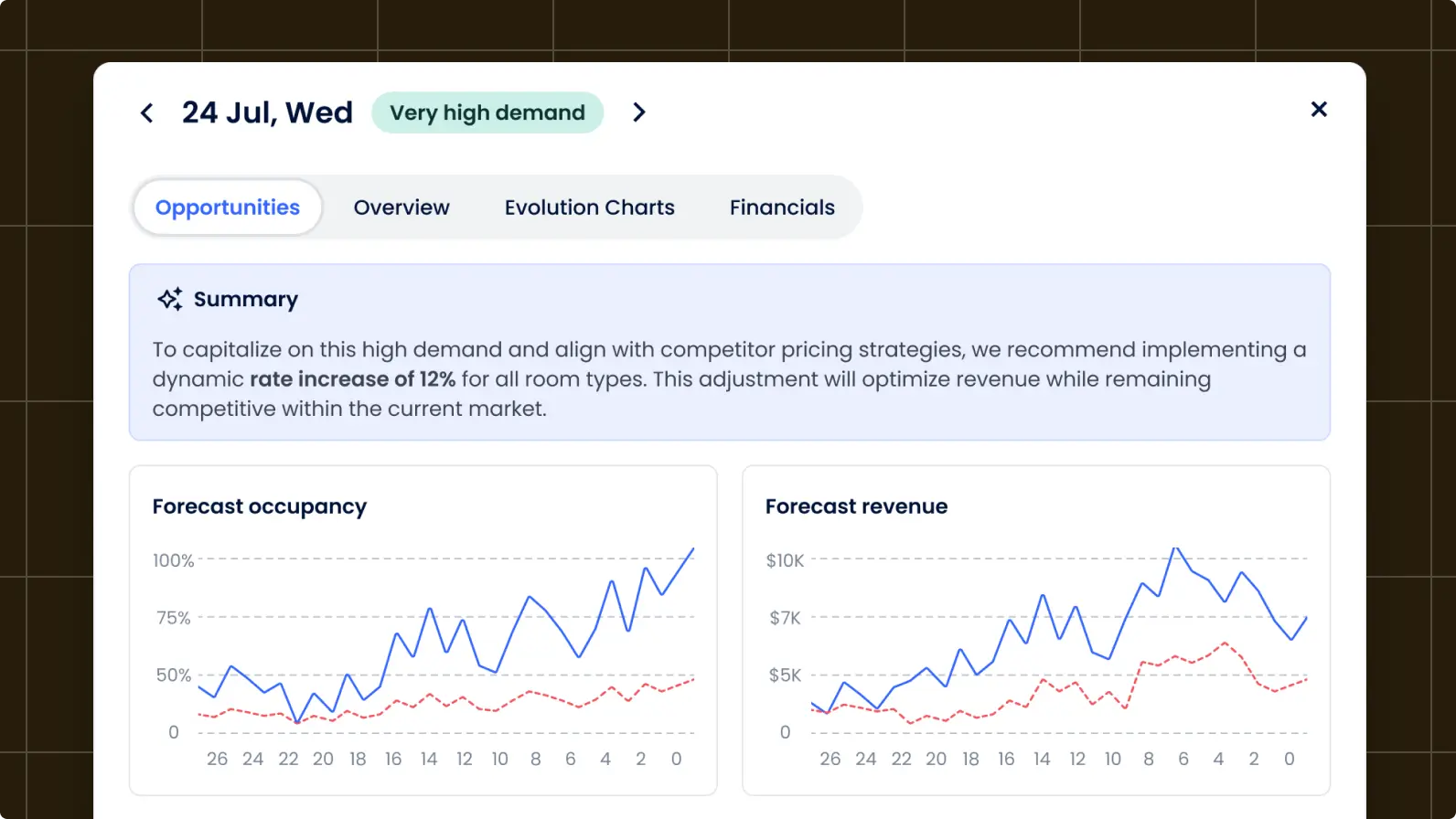
Just as important as what you sell is how you price it. Independence makes it possible to move away from static pricing models and toward dynamic, demand-driven rates informed by forward-looking data.
How Cloudbeds can help
With tools like Cloudbeds RMS, hotels can analyze billions of data points to understand the unique drivers of their demand, not just market averages. The result is 90-day forecasts with up to 95% accuracy, helping properties lift revenue by up to 18%, even during slower periods.
Because every pricing recommendation is tied to projected financial impact, revenue teams can see the upside before taking action, building confidence in every decision.
When paired with Cloudbeds Guest Marketing CRM, pricing strategy becomes even more powerful. Hotels can identify need periods early and trigger targeted promotional campaigns to the right guests at the right time, filling gaps without relying on blanket discounts.
2. Design a guest experience that reflects who you are
Without brand-mandated service models or scripts, independent hotels can rethink the entire guest journey from first message to check-out and decide what hospitality looks like on their own terms. That might mean elevating high-touch moments, simplifying others, or removing steps that no longer add value.
The key is intention. Reinventing the guest experience doesn’t mean doing more; it means doing what matters.
That starts with a clear understanding of:
- Who your target guest is
- What they value most
- How your staffing model realistically supports that experience
For many independent hotels, this shows up in small but meaningful shifts. Digital check-in can reduce front desk pressure and free staff to focus on guests who actually want in-person support. Guest messaging can replace unnecessary calls down to the front desk with faster, more convenient communication.
Some hotels go even further, reimagining the role of the front desk entirely, instead turning it into a flexible service hub, or in some cases, removing it altogether.
How Cloudbeds can help
With Cloudbeds Guest Experience, hotels can deliver high-touch hospitality at scale without adding complexity behind the scenes.
Hotels can tailor the guest journey by segment — offering different digital experiences for direct bookers, repeat guests, or VIPs — and customize check-in flows to include only what’s necessary for each stay. Guest communication is centralized in a single inbox, allowing teams to respond quickly and consistently on the channels guests already prefer.
And for properties embracing a more contactless model, integrations with digital key providers make flexible arrival and access possible.
3. Tell your story your way
When you leave a brand, you’re no longer borrowing someone else’s voice. You’re responsible for how your hotel shows up.
The strongest independent brands build identity deliberately across a few key channels:
- Your website becomes your primary storefront. It should clearly communicate who you are, who you’re for, and why guests should book direct
- Social channels are where personality comes through. This is where you show the human side of your property
- PR opens the door to stories brands rarely tell — local collaborations, design decisions, sustainability efforts, or community impact
- Paid media reinforces your positioning. Strong creative and clear messaging help attract the right guests, not just more traffic.
- SEO & GEO helps you be discoverable. Clear positioning, local relevance, and useful content help guests find you when they’re actively planning a trip
- Blogs, guides, emails, and landing pages are how you build trust over time. Content gives guests confidence before they ever arrive.
Travelers are ditching search engines for AI.
Discover GEO strategies to help your hotel win trust signals and be recommended by AI.
How Cloudbeds can help
With Cloudbeds Digital Marketing, hotels can control their narrative and turn visibility into direct revenue.
Hotels can manage metasearch campaigns from a single interface to stay visible at the moment travelers compare options. Retargeting helps bring interested guests back with AI-built ads that reconnect them to their booking, while giving hotels full control over budget and performance tracking.
Hotel PMax extends reach across Google Search, Display, YouTube, Maps, and Gmail, making it easier to connect with high-intent travelers without juggling multiple campaigns. And with Cloudbeds Websites, everything comes together, driving up to 25% more direct bookings through a site that’s fully connected to booking, messaging, and upsells.
4. Align commercial teams around shared goals
Independence makes it possible to bring revenue, marketing, and sales back onto the same page.
Under a brand, these teams often operate in silos, guided by different data sources, timelines, and priorities. Campaigns are launched according to brand calendars rather than real demand, and opportunities are missed as a result. After deflagging, that constraint disappears.
Independent hotels can replace siloed planning with a single commercial strategy—one where teams work toward shared goals and act on the same signals. Revenue identifies opportunity, marketing activates demand, and sales supports the right segments at the right time.
How Cloudbeds can help
With Cloudbeds, integrated systems allow commercial teams to work from a shared source of truth.
Demand forecasts from Cloudbeds Revenue Intelligence surface need periods early, before occupancy gaps turn into revenue loss. Those insights can then trigger action across the commercial stack. When paired with guest data from the CRM, hotels can identify the most relevant audience and launch targeted campaigns with precision.
For example, if forecasts reveal soft occupancy two weeks out and guest data shows a segment of past guests who historically book midweek stays during shoulder season, marketing can trigger a direct booking campaign with a tailored offer. This fills need periods without discounting weekends or cannibalizing high-demand nights.
Understand how modern forecasting really works.
Go deeper into the models behind long-range demand forecasting.
5. Turn physical spaces into revenue drivers
Deflagging gives hotels permission to rethink how their physical spaces are used and what role they play in the business.
Under a brand, spaces are often fixed by standards: business centers, lobbies, meeting rooms, or lounges that exist because they’re required, not because they perform. Independence removes those constraints.
A former business center might become a coworking lounge for remote workers. A quiet lobby could evolve into a café, wine bar, or social hub. Meeting rooms can host pop-ups, events, or content creation studios.
The most successful independent hotels design spaces that serve more than one audience:
- Guests, who are looking for convenience, experience, and connection
- Locals, who bring consistent foot traffic and repeat spend
- The community, through events, partnerships, and shared use
How Cloudbeds can help
With Cloudbeds, ancillary revenue doesn’t have to create operational complexity.
Cloudbeds POS and alternative integration partners support on-property services by centralizing order processing, billing, and inventory management. Charges from cafés, bars, coworking spaces, or events can post directly to the folio, giving both staff and guests a seamless experience from purchase to checkout.
On the revenue side, Cloudbeds Revenue Intelligence tracks multiple revenue streams — not just rooms — allowing hotels to understand how spaces perform, forecast demand, and optimize pricing across the business. Instead of treating ancillary revenue as an afterthought, hotels can manage it strategically, with visibility into what’s working and where there’s room to grow.
6. Get creative with distribution
Instead of relying on a single brand-led distribution strategy, independent hotels can experiment with a broader mix of channels, testing niche OTAs, strengthening relationships with travel agents and groups, and gradually shifting more demand toward direct bookings when the timing is right.
The goal isn’t to abandon OTAs overnight. It’s to diversify intelligently. Independence allows hotels to decide which channels are worth the cost, which audiences they reach best, and how each channel fits into the broader commercial strategy.
How Cloudbeds can help
With Cloudbeds, independent hotels can manage distribution centrally while maintaining flexibility across channels.
Cloudbeds Channel Manager, Booking Engine, and CRS integrations allow hotels to connect directly to 300+ global, regional, and niche OTAs, as well as GDS and travel agency networks. Inventory and rates are synced in real time, 24/7, eliminating double bookings and manual updates.
Hotels sell from a single pool of inventory, with automatic mapping between the PMS, channel manager, and booking engine. This makes it easy to set different pricing by channel, sell in multiple currencies, and tailor automated guest communications based on where the booking originates.
Direct bookings are supported by a mobile-first, conversion-optimized booking engine that reflects your brand from the first click. Guests book faster, in their own language and currency, while hotels regain control over the booking experience and save up to 30% in OTA commissions every time a guest books direct.
7. Redefine loyalty around relationships, not points
Losing a big-brand loyalty program doesn’t mean losing loyal guests. It means changing why guests come back.
Brand loyalty programs tend to reward frequency with points. Independence rewards relationships. While deflagging may naturally filter out guests who book purely for points, it often strengthens connections with guests who value recognition and meaningful experiences. These are the guests most likely to return, recommend your hotel, and engage directly with you online.
That shift does require intention. Independent hotels need to invest more actively in reputation management and rethink what loyalty looks like without a points ledger.
How Cloudbeds can help
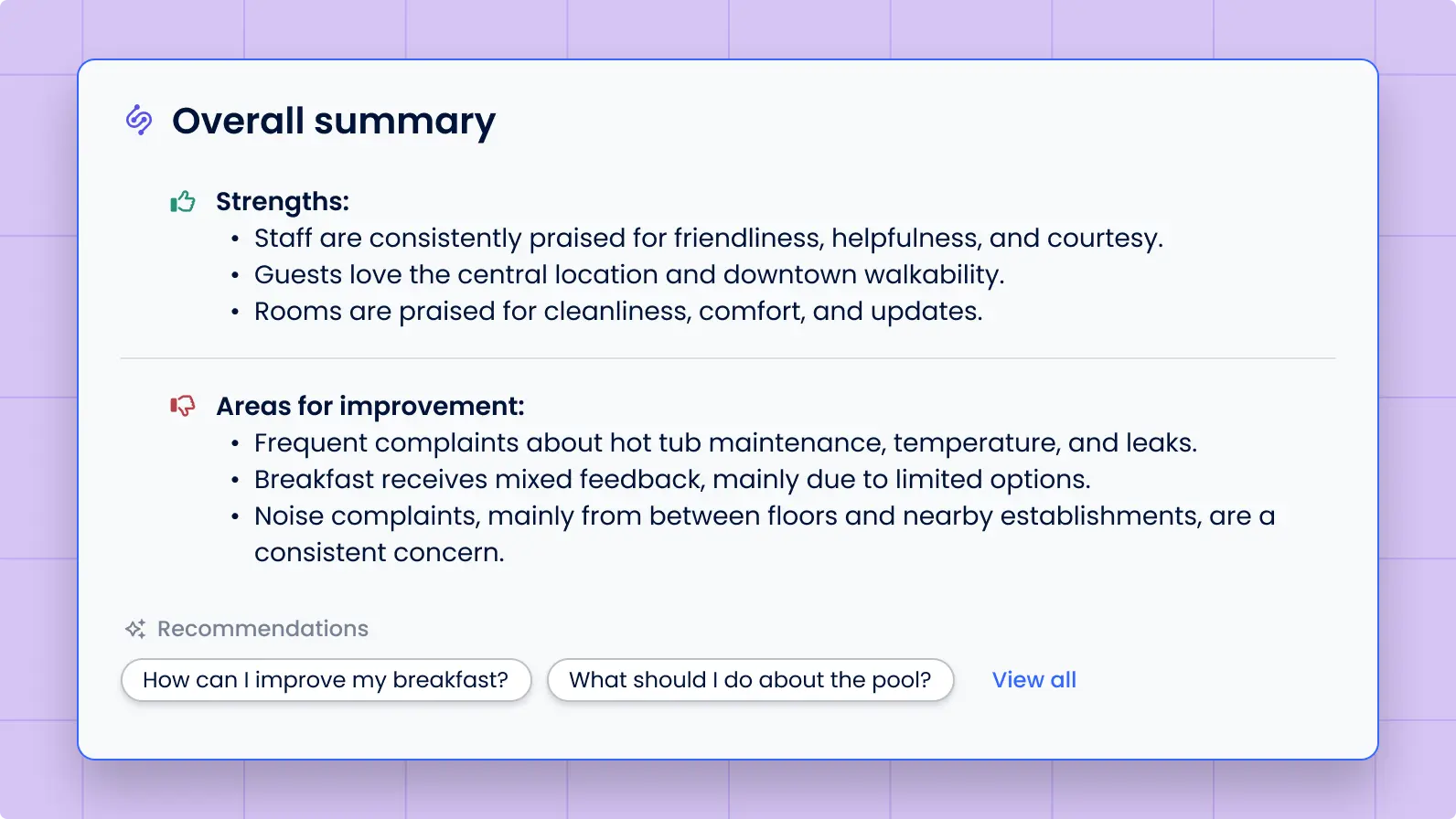
With Cloudbeds Reputation Management, hotels can monitor and respond to guest reviews from a single, unified dashboard. AI-generated response suggestions help teams reply quickly and consistently, while sentiment analysis highlights what guests appreciate most and where there’s room to improve. This makes reputation management proactive rather than reactive.
On the loyalty side, Cloudbeds Guest Marketing CRM allows hotels to build relationships without points. Teams can segment guests based on stay history, booking behavior, or preferences, then create targeted campaigns with special rate plans, exclusive packages, or personalized offers. These campaigns can be automated, ensuring guests feel recognized without adding manual work for staff.
8. Use technology that fits your workflows
One of the most liberating parts of independence is the ability to choose technology that actually fits how your hotel operates.
Without brand-mandated systems or slow approval cycles, independent hotels can adopt tools that support their real workflows and staffing realities. That means moving faster on innovation like AI-powered insights, guest messaging, upsells, digital keys, and automation without waiting months for permission or rollout windows.
This is where many independent hotels gain an immediate operational edge. Technology becomes a way to simplify work, reduce manual tasks, and give teams more time to focus on guests. Instead of forcing your operation to adapt to rigid systems, your systems adapt to you.
Taken together, the strategies above all rely on this flexibility. Independence allows hotels to build a tech stack that supports the way they want to run and evolve it as needs change.
How Cloudbeds can help
With Cloudbeds, hotels can build a unified, flexible tech stack without sacrificing simplicity.
Cloudbeds brings core operations, distribution, guest experience, and revenue marketing together on a single platform, supported by a broad ecosystem of integrations. This allows hotels to adopt new capabilities at their own pace, without breaking workflows or retraining teams from scratch.
Independence, built to last
The move to independence is led by bold hoteliers ready to challenge the status quo. It’s not the easier route, but it is the more rewarding one.
Hotels that choose independence gain control over pricing, guest relationships, and the way their business actually operates. With the right planning, alignment, and technology, deflagging becomes less about what’s lost and more about what’s possible.
Join thousands of independents.
See how Cloudbeds helps hotels navigate deflagging, stabilize fast, and build a business built to last.