The numbers are brutal but honest: On average, 98% of hotel website visitors leave without completing a booking. That’s not a pricing or product problem. It’s a follow-up problem.
Travelers browse, compare, get distracted, and move on. The OTAs and chains chasing them with retargeted ads understand this. Most independent hotels don’t (or don’t have the tools to act on it).
Hotel retargeting ads fix the follow-up gap. They track visitors who showed genuine interest in your property, then resurface your brand online— on news sites, travel blogs, Google’s display network — until that traveler comes back and books direct. For marketing and revenue managers looking to reduce OTA commissions without sacrificing occupancy, retargeting is one of the highest-ROI channels available.
This guide covers how hotel retargeting works, why the timing and targeting decisions matter more than most hotels realize, and how to run campaigns that convert browsers into paying guests.
What are hotel retargeting ads?
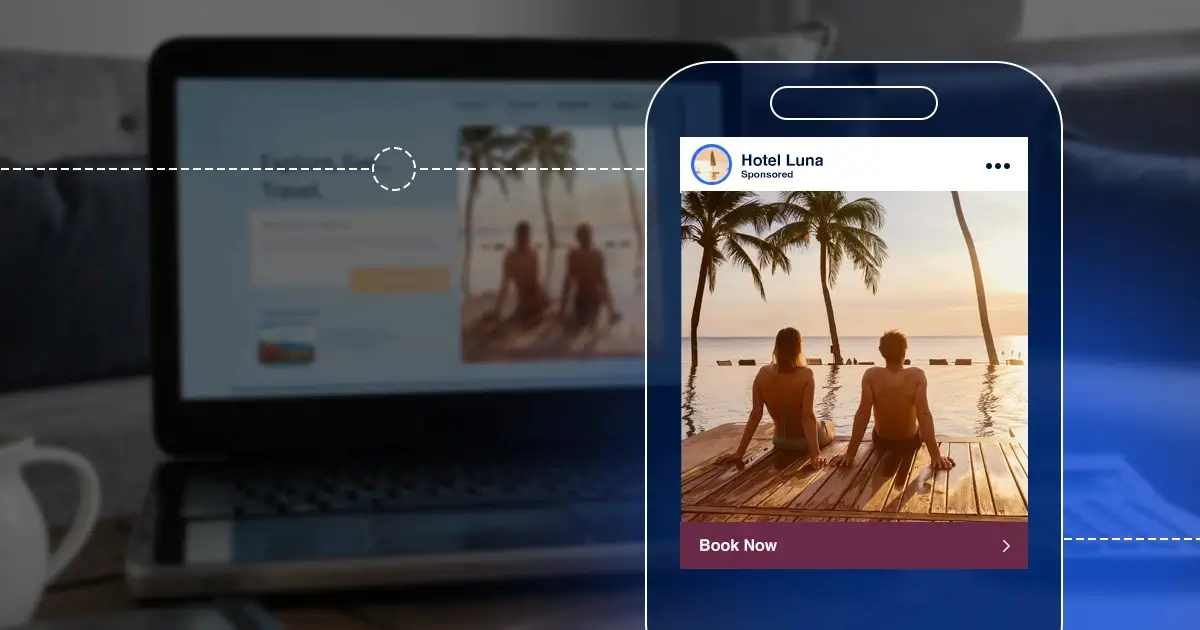
Hotel retargeting ads are display advertisements shown to travelers who previously visited your hotel website or booking engine but did not complete a reservation.
Using tracking pixels, cookies, or first-party audience data, retargeting campaigns follow these high-intent visitors across different websites and deliver personalized ads that bring them back to book directly. Unlike cold display ads targeting new audiences, retargeting reaches people who already know your property, making them a more effective use of ad spend.
Why travelers leave without booking
Before exploring how retargeting works, it’s worth understanding why abandonment rates are so high.
Industry research shows that around 84% of online hotel bookings are abandoned, while a SiteMinder study of 12,000 travelers across 14 countries found that more than half abandoned a booking specifically because of a poor digital experience.
84%
of online bookings are abandoned
52%
abandon due to a poor digital experience
What this tells you is that a large share of your abandoned visitors wanted to book. They just hit a friction point or got distracted. Retargeting is your recovery opportunity, but only if your booking experience is also worth returning to. Retargeting drives the traffic back, but your website and booking engine have to do the conversion work from there.
Most people who visit your website and booking engine don’t book immediately. Retargeting brings them back. It follows that warm audience around the web and brings them back to complete the booking.
For a hotel paying 15–25% OTA commissions, even modest shifts of that traffic toward direct bookings compound meaningfully over a full booking year.
Remarketing and retargeting are often used interchangeably, but they describe different tactics.
| Retargeting | Remarketing |
| Definition | Display ads shown to past website visitors who didn’t book | Outreach to guests who have previously stayed with you |
| Audience | Anonymous visitors tracked by pixel/cookie | Known guests in your database |
| Goal | Convert browsers into first-time bookers | Drive repeat stays and loyalty |
| Channel | Google Display Network, partner websites | Email, SMS, WhatsApp, social ads |
| Timing | During the active research window (days to weeks post-visit) | Pre-stay, post-stay, seasonal re-engagement |
| Data required | Website tracking pixel | Guest records from PMS/CRM |
Think of retargeting as the top of your direct booking funnel, capturing high-intent travelers before they default to an OTA, and remarketing as the engine that turns a single stay into a long-term guest relationship. You need both, but they are inherently different marketing strategies.
Looking for remarketing strategies?
Learn how to stay connected with guests long after checkout.
How hotel retargeting campaigns work
Here is a breakdown of the key components required for a retargeting campaign.
The tracking pixel
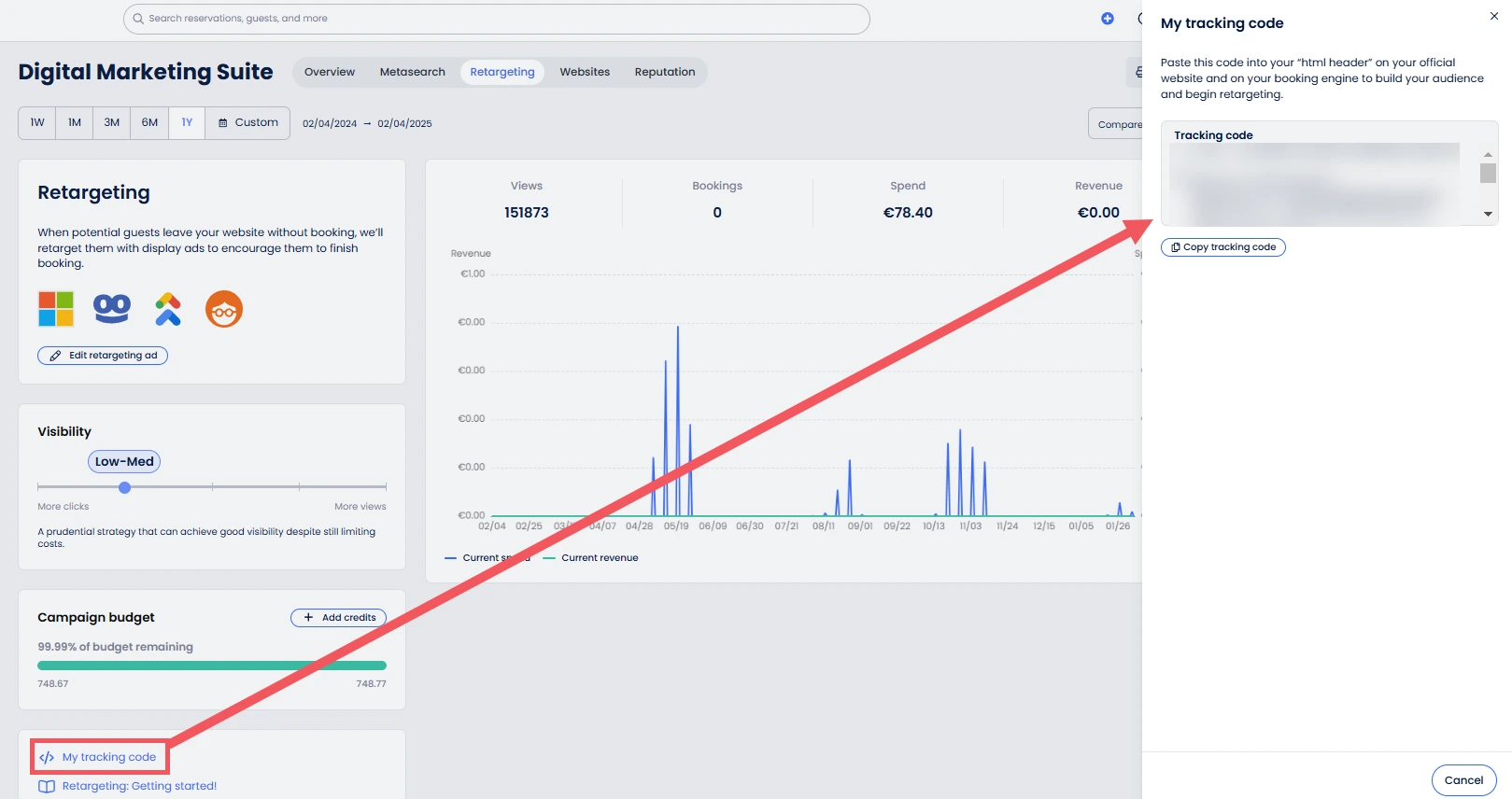
When a traveler visits your hotel website or booking engine, a small snippet of code, also called a tracking pixel or retargeting script, places a cookie in their browser. This lets your ad platform anonymously identify that visitor and add them to your retargeting audience. From that point, your ads can follow them across thousands of partner websites in the display network until the cookie expires (typically 30–90 days) or they convert.
No personally identifiable information is collected in this process since retargeting operates on anonymous behavioral signals, which is part of why it remains effective even as privacy restrictions increase.
With Cloudbeds Digital Marketing, the tracking code is automatically added to the Cloudbeds PMS and Booking Engine, helping hotels start building retargeting audiences immediately.
Real-time bidding
Retargeting campaigns run on real-time bidding (RTB) infrastructure. Every time one of your past visitors loads a webpage with an available ad slot, an auction happens in milliseconds. Your platform bids for the impression based on your budget, bid strategy, and the visitor’s profile.
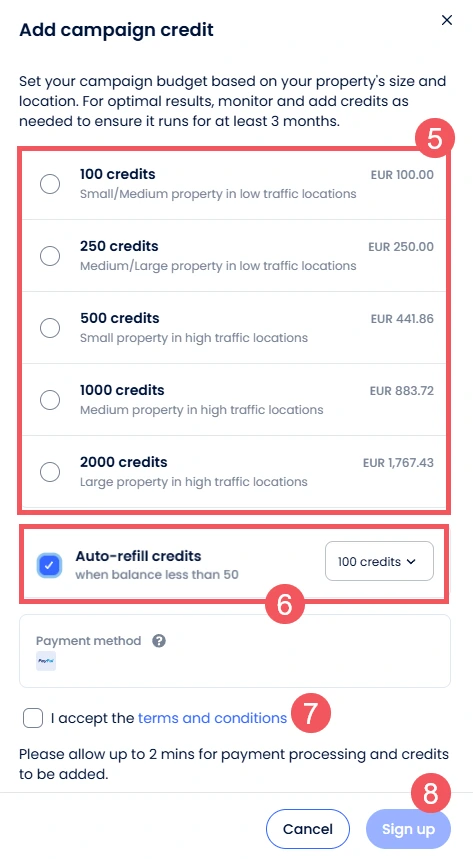
In Cloudbeds, hotels control how aggressively campaigns compete for impressions by managing campaign funding and ad credits directly within the platform. Auto-refill functionality can automatically replenish campaign credits to help ads continue running without interruption, an important factor since retargeting performance improves as campaigns gather more data and optimization signals over time.
Audience segmentation
Not all site visitors are equal. A traveler who viewed your rooms page and started a booking form is much closer to converting than one who only hit your homepage.
Smart segmentation for hotels looks like this:
- Booking engine abandoners — your hottest audience; serve urgency-driven creative with direct rate visibility
- Rooms page viewers — still in research mode; serve aspirational content that reinforces property quality
- Homepage visitors only — earliest stage; serve brand awareness ads rather than book-now pushes
- Date-specific browsers — visitors who searched specific travel dates; ads can reference those dates or nearby availability
- Mobile visitors — behaviors and conversion barriers differ from desktop; tailor creative and CTA accordingly
The content gaps most hotel retargeting campaigns miss
These are the overlooked details that often determine whether retargeting drives incremental direct bookings or burns through ad spend.
1. Creative that matches their expectations
Retargeting works best when the creative feels familiar. Travelers are more likely to engage with ads that reinforce what they already saw on your website, including recognizable imagery, branding, room types, or messaging that keeps your property top of mind as they continue researching elsewhere online.
I suggest you use something from the homepage of your website that people are used to seeing associated with your property that they likely saw when they came and visited your website.
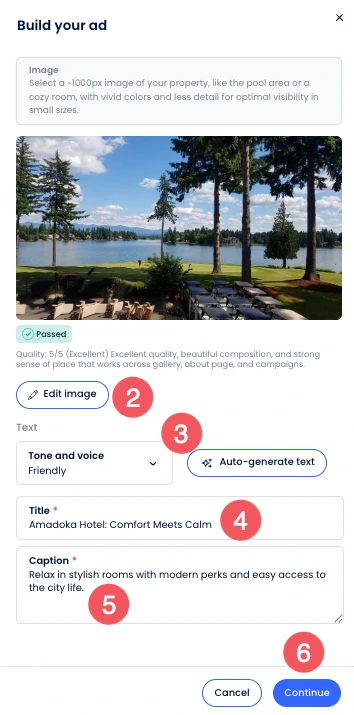
What does a retargeting ad look like?
Most hotel retargeting ads are simple display ads designed to keep your property top of mind after a traveler leaves your website. Rather than creating dozens of complex campaigns, a typical ad includes:
- A recognizable property image
- An ad title
- An ad caption
With Cloudbeds, the image is evaluated by an AI image quality validator ad users can use AI to auto-generate text based on the chosen tone and voice.
2. The mobile experience
A retargeting click that lands on a slow, non-mobile-optimized booking engine is money wasted. Retargeting drives return traffic; your booking engine determines whether that traffic converts. A 2-step mobile checkout, pre-filled date fields, and transparent pricing at every step are requirements for making retargeting ROI-positive on mobile.
3. Frequency capping
Over-retargeting damages the guest relationship before it even starts. Seeing the same property ad 20 times in a week pushes travelers away rather than drawing them in. Set frequency caps (typically 5–7 impressions per week per person is considered a reasonable ceiling) and monitor frequency metrics in your dashboard.
4. Retargeting as part of a full funnel, not a standalone channel
Retargeting is most powerful when it recaptures traffic generated by your other channels. A traveler who found your property via a Google Hotel Ads click, browsed your site, and left is exactly the profile retargeting was designed for. When metasearch, PMax, and retargeting run from the same platform with unified attribution, you can see the full journey and allocate budget accordingly.
Hotels that add retargeting to metasearch see 205% more net sales than those who just use metasearch ads alone. It increases the efficiency of that metasearch ad campaign.
Key metrics for measuring retargeting performance
Retargeting is primarily a visibility and re-engagement channel, so the right metrics look different from search or metasearch campaigns.
| Metric | What it tells you |
| Impressions | How often your ads are being served |
| Click-through rate (CTR) | How often people click after seeing the ad |
| Cost per click (CPC) | What you’re paying per visit driven |
| Conversion rate | Clicks that result in bookings |
| Return on ad spend (ROAS) | Revenue generated per dollar spent |
| Cost per acquisition (CPA) | What each incremental direct booking cost you |
| Frequency | Average impressions per person |
A note on attribution: Many retargeting-influenced guests return to your site through other means, like direct navigation or Google search, before booking. Last-touch attribution undervalues retargeting’s contribution. Look at assisted conversion data and view-through attribution windows (typically 30 days) to get a fuller picture.
The key difference with retargeting is that people don’t really click on the ads that much. They’re banner ads, equivalent to billboards or print ads. So that reach and frequency is about keeping your hotel top of mind as they’re thinking about making a booking.
How to run a hotel retargeting campaign
Ready to get started with retargeting? Here are the steps to run your first campaign.
Step 1: Install your tracking pixel
Your tracking pixel needs to fire on every page of your website and booking engine. Pay particular attention to:
- The booking engine search/results page (high-intent signal)
- Room detail pages
- The booking form itself (your most valuable abandonment audience)
- Confirmation page (to exclude converters from your retargeting pool)
If converters aren’t excluded, you’ll waste budget retargeting guests who already booked and create a confusing experience for them.
Step 2: Build segmented audience lists
At minimum, create separate lists for: all site visitors, booking engine visitors, and booking abandoners. As your campaigns mature, add date-specific, page-specific, and device-specific segments.
Step 3: Set your creative strategy by segment
Match ad content to audience intent. Booking engine abandoners need urgency and rate clarity. Room page browsers need aspiration and proof of quality. Homepage visitors need brand awareness. Where possible, use dynamic creative that automatically surfaces relevant room images, dates, or offers based on what the visitor viewed.
Step 4: Choose your bidding approach
Most managed retargeting tools default to automated bidding, which optimizes toward your stated goal (conversions, traffic, or visibility). Give any new campaign at least 3 months to gather meaningful data before drawing conclusions or making major adjustments.
Step 5: Ensure your booking engine is ready
Over half of travelers abandon a booking because of a poor digital experience. Before running any retargeting campaign, confirm your booking engine offers mobile-optimized checkout, transparent pricing at every step, and a fast load time.
Step 6: Monitor, optimize, and expand
Watch CTR, CPA, and ROAS weekly in the first month. If CTR is low, test new creative. If conversion rate is low, audit your booking engine experience. If ROAS is low, refine audience segmentation. Once your core retargeting campaign is performing, layer in the broader full-funnel picture.
Partnering with Cloudbeds has been a game-changer for Plaza La Reina. In just three months, we saw an 8x ROI on Metasearch and a 24x ROI on Retargeting, with guests staying longer — exactly what we aim for. The results have been measurable and meaningful, we couldn’t be happier!
Plaza La Reina’s 24x retargeting ROI in three months illustrates what happens when retargeting runs on a platform that’s natively connected to the booking engine and PMS — every click is trackable all the way through to a confirmed reservation, with no attribution gaps or disconnected reporting.
How Cloudbeds Digital Marketing handles retargeting
Running effective retargeting requires technical infrastructure most independent hotels don’t have the internal bandwidth to build and manage: pixel implementation, audience segmentation, creative testing, bid optimization, and attribution tracking across the full journey from first visit to confirmed booking.
Cloudbeds Digital Marketing handles this end-to-end, purpose-built for hospitality.
What’s included:
| Feature | How it helps hotels run retargeting campaigns |
| Automated retargeting campaigns | Campaigns are set up once, while AI continuously manages bid optimization, audience targeting, and ad delivery |
| Personalized display ads | Ads pull from your property’s visual assets to keep your hotel visible across the web after travelers leave your site |
| Full-funnel reporting dashboard | Retargeting performance appears alongside metasearch and Hotel PMax data, giving hotels a complete guest acquisition view |
| PMS-connected attribution | Retargeting-influenced bookings are tied directly to reservations in Cloudbeds, connecting ad spend to actual revenue |
| Real-time performance tracking | Impressions, clicks, bookings, and ROAS are visible in one dashboard without requiring third-party reporting tools |
| Flexible budget controls | Hotels can adjust campaign spend using ad credits starting at $100 |
The key differentiator is platform integration. When your retargeting, booking engine, and PMS share the same data layer, attribution is exact, not estimated. You know precisely which campaigns contributed to which reservations, which lets you optimize spend with confidence rather than guesswork.
Retargeting in the context of your digital marketing strategy
Retargeting doesn’t work in isolation. It captures the tail end of journeys that began somewhere else. Its ROI is directly tied to the quality of traffic your other channels drive.
When these components run from the same platform, the data flows automatically. When they’re managed through separate vendors, every handoff is a potential attribution gap and a reason your ROAS looks worse than it actually is.
Key takeaways
- Retargeting helps hotels reconnect with travelers who already showed booking intent.
- Most travelers don’t book on their first visit, which is why retargeting exists.
- The strongest retargeting campaigns combine recognizable creative and a frictionless booking experience.
- Retargeting works best as part of a connected marketing stack.
- Retargeting keeps your direct booking channel in the conversation longer.
- Retargeting is about staying top of mind during the critical window between research and booking.
- A connected PMS, booking engine, and retargeting platform gives hotels clearer attribution, better audience targeting, and more profitable direct bookings over time.
Don’t waste your website traffic.
With Cloudbeds, build retargeting campaigns in seconds and turn visitors into guests.