The AI capability you buy this year could be obsolete by 2029, not because the technology has moved on, but because it was built on the wrong foundation.
That’s the argument Cloudbeds CEO Adam Harris made at the Skift Data + AI Summit 2026, and it’s one that every hotelier evaluating AI tools right now should take seriously. His case: most of what’s being pitched as AI today is probabilistic — it answers questions, generates impressive demos, makes educated guesses. The AI that actually runs a hotel takes action with certainty. One is a solid demo, while the other is what accelerates your business.
Hotel CEOs who sign multi-year platform contracts in 2026 on the strength of AI capability demos are committing to architecture that will be obsolete within three years.
For GMs, revenue managers, and operators choosing hotel management software in 2026, that distinction determines whether the platform you commit to is a genuine revenue engine or just a very expensive dashboard.
This article breaks down what AI hotel management software actually does, why architecture determines whether it delivers, and what to look for before you sign anything.
Key takeaways
- AI hotel management software delivers real revenue when it’s built on a unified data layer.
- The most impactful AI capabilities right now are demand forecasting, dynamic pricing, and guest marketing automation.
- Probabilistic AI (that answers questions) and deterministic AI (that takes action) are fundamentally different architectures; evaluate which one you’re actually buying.
- The AI assistant and chatbot category is maturing fast; the gap between generic scripts and property-trained NLP models is significant for guest experience and staff efficiency.
- Unified platforms that share data across PMS, revenue intelligence, channel manager, and marketing are structurally better at AI because every model has the full context it needs
- As AI booking agents emerge, machine-readable supply and clean distribution APIs will become competitive advantages, not just technical requirements
What is AI hotel management software?
Artificial intelligence hotel management software is a platform that applies machine learning, predictive analytics, and large language models to automate decisions and surface recommendations across hotel operations.
Where traditional hotel software records and reports on what happened, AI hotel management software anticipates what’s coming and acts on it: adjusting rates before demand peaks, sending a marketing campaign before a need period develops, flagging a guest’s preferences before they check in.
The key capabilities typically include dynamic pricing and demand forecasting, guest marketing automation, reputation management and sentiment analysis, operations automation, and AI-powered chat and virtual assistants. But the question that matters more than any feature list is: where does the AI live, and what is it connected to?
Why most hotel AI implementations underdeliver
According to a 2026 study by Canary Technologies, 71% of hospitality professionals say AI is having a significant or transformative impact on the industry, and 82% expect their AI usage to increase within the next year. While the headline numbers are strong, the reality is more complicated.
71%
say AI has a transformative impact
82%
expect AI usage to increase within the next year
Adam argues that most operators aren’t failing because they lack the right tools. They’re failing because they haven’t clearly defined the problem, and they’re sitting on fragmented data that makes even the best AI useless.
This is the structural problem with bolt-on AI. When a revenue management system, a guest experience platform, a CRM, and a booking engine all run on separate data models, each one is working from a different version of the truth. Your dynamic pricing tool doesn’t know that a long-stay guest is checking in. Your marketing CRM doesn’t know that Saturday night is tracking soft. Your AI chatbot doesn’t know what the guest paid or what they’ve asked for before.
The issue is that general-purpose AI systems lack deep hospitality-specific understanding, and even purpose-built tools fail when they can’t access the full picture of what’s happening at a property.
The fix isn’t more AI tools, but a unified architecture that gives AI a single, connected data layer to work from
The unified advantage
A unified architecture means every part of your tech stack — property management system, channel manager, booking engine, guest marketing, revenue intelligence, payments — shares the same underlying data model and updates in real time.
That matters for AI in three specific ways.
1. Forecasting accuracy compounds
When demand signals, competitor pricing, event data, booking pace, occupancy rates, and guest segment data all flow into the same model, forecasts get dramatically more accurate.
Cloudbeds RMS — the only causal AI built exclusively for hotels — achieves up to 95% forecast accuracy over a three-month window. Competing general models are trained on just 0.004% of hospitality data, which means they don’t understand your market, your property, or your customers.
During Passport, Head of Machine Learning at Cloudbeds, explained how Signals was built to turn forecasting from a snapshot into a movie.
Watch the full session.
How Signals turns a snapshot into a moving picture of demand.
2. Recommendations can trigger actions
On a fragmented stack, an AI tool might surface a recommendation and wait for a human to act on it. On a unified platform, a soft-period occupancy forecast can automatically generate a pricing recommendation, identify the guest segments most likely to fill the gap, draft a targeted marketing campaign, and push updated rates across OTAs.
Using causal AI and generative AI (GenAI) together, the platform moves beyond reporting and into orchestration. One model identifies the factors influencing demand and profitability; the other helps translate those insights into actions that can be executed immediately.
3. Guest data becomes an organizational asset
When PMS guest profiles sync automatically to a CRM, and the CRM feeds the booking engine and the revenue tools, every interaction a guest has with your property — past stays, ancillary spend, booking source, communication history — is available to every system in real time.
For AI, that context is invaluable. It can identify which guests are most likely to rebook, which offers are most likely to convert, and which communication channel will be most effective. The result is personalization that feels intentional and automation that improves both guest experience and revenue performance.
What AI actually does in hotel management software
Here’s where purpose-built AI in hospitality creates measurable impact across specific areas of operations.
Revenue management and dynamic pricing
AI-powered revenue management systems analyze forward-looking booking data, competitor rates, local events, weather, and market health indicators to generate rate recommendations at the room-type level with explainability, so your team understands why each recommendation is being made, not just what it is.
For properties running a full-stack approach, automation takes this further. Guardrails (floor and ceiling rates) let revenue managers set the boundaries; the system executes within them.
Demand forecasting
Traditional forecasting is a snapshot of last year’s numbers, yesterday’s occupancy, and a best guess at what next month looks like. AI-powered demand forecasting is a continuously updating model. Every new booking, search query, competitor rate change, or event announcement flows into the forecast in real time.
The practical impact: revenue managers stop reacting and start anticipating. A GM at a boutique property can see that Saturday three weeks out is tracking soft, then immediately understand why (a competitor just dropped rates, a previously expected event was cancelled) and take action before the gap becomes a problem.
Guest marketing CRM
When AI is connected to guest profiles across the full PMS, dynamic audience segments build themselves:
- High-value guests
- OTA bookers due for a win-back
- Guests with birthdays or anniversaries coming up
- Guests who stayed six months ago and statistically are about to plan their next trip
AI-generated campaigns can match the segment to the moment with copy, offer, and timing recommendations built from actual booking behavior. And revenue attribution tracking closes the loop: not just email open rates, but actual reservations generated, traced back to the campaign that prompted them.
AI chatbots and virtual assistants
A growing category in hotel management software is the AI assistant, which is a chatbot powered by natural language processing that learns from a hotel’s own materials. Basically, a digital brain trained on a specific property’s SOPs, OTA listings, website content, and policies.
The result: guests and employees get accurate, on-brand answers to questions at any hour, in their own language. Front desk time shifts toward the guest interactions that actually require a human, helping streamline operations and improve guest management.
Cloudbeds recently launched Ask Signals, which allows users to ask questions and get immediate answers from within the platform.
Watch the full session.
See how Ask Signals turns your property’s data into actionable recommendations.
Reputation management and sentiment analysis
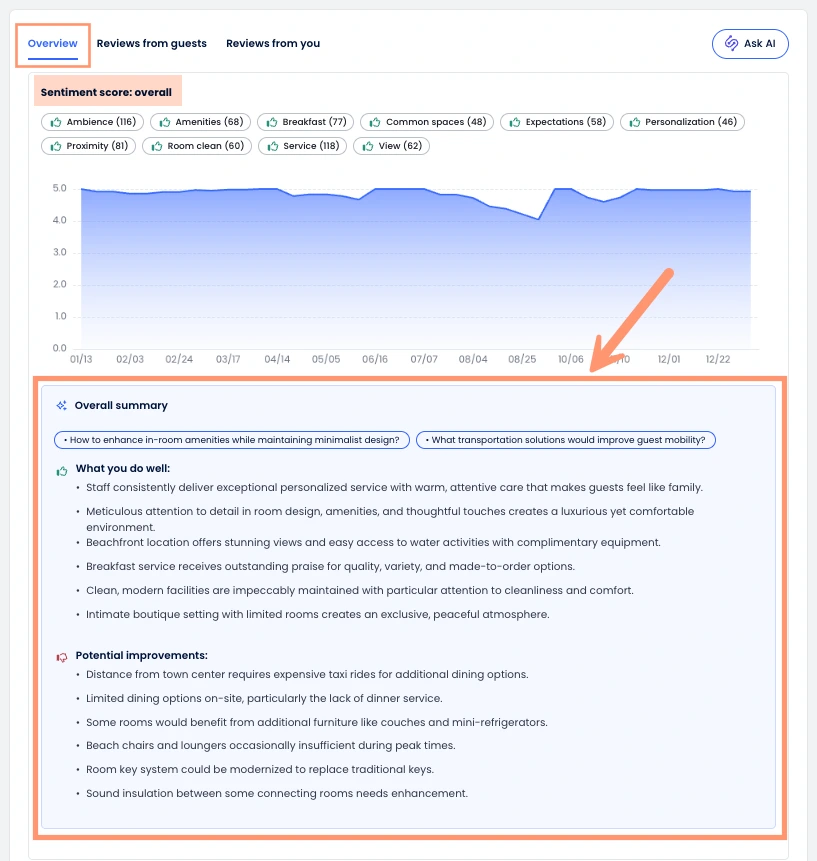
AI tools can monitor reviews across platforms in real time, categorize feedback by theme (cleanliness, service, value, amenities), flag issues before they become patterns, and generate on-brand responses. For multi-property operators, this turns what was once a manual, time-consuming task into an automated signal feed.
Cloudbeds Reputation Management uses AI to uncover the why behind your review, showing what guests appreciate the most and which areas may need improvement, along with:
- Automatic tagging of emotions
- Detection of the top 10 recurring themes
- Trend tracking
- AI-generated replies to reviews
What to look for in AI hotel management software
| Capability | What good looks like | Red flag |
| Revenue management | Property-specific model, explainable recommendations, autopilot with guardrails | Generic pricing rules, no “why” behind recommendations |
| Demand forecasting | Real-time updates, 90%+ accuracy, event and competitor data included | Point-in-time snapshots, no external data signals |
| Guest marketing | CRM synced to PMS, dynamic segments, revenue attribution | Batch-and-blast email, no booking data connected |
| AI chatbot | Trained on property-specific content, NLP-powered, multi-language | FAQ widget with fixed responses |
| Data architecture | Single data model across PMS, distribution, marketing, payments | Separate logins, manual exports between systems |
| Transparency | Explainable AI with human override | Black-box recommendations with no rationale |
How Cloudbeds approaches AI in hotel management software
Cloudbeds’ approach to AI starts with a simple premise: AI is only as powerful as the data it can access.
Rather than building standalone AI tools and connecting them later, Cloudbeds applies AI across a unified platform where operations, distribution, guest experience, and revenue marketing all share the same underlying data model. Reservations, pricing, guest profiles, payment activity, marketing performance, and operational data are continuously updating and available to the same intelligence layer.
That creates opportunities that fragmented systems struggle to replicate.
What that enables in practice
| Area | How AI is applied |
| Revenue management | Forecast demand, recommend pricing changes, identify need periods, and automate rate updates within defined guardrails |
| Digital marketing | Generate ad creative, optimize bidding, identify target audiences, and launch campaigns designed to drive direct bookings |
| Guest marketing | Build audience segments automatically, generate personalized emails, and recommend campaigns based on booking behavior and demand forecasts |
| Guest experience | Power AI-assisted guest communication, answer common questions, surface guest preferences, and personalize interactions before, during, and after a stay |
| Reputation management | Analyze guest reviews and survey responses, identify recurring themes, and draft review responses aligned with the property’s tone of voice |
| Operations | Surface operational trends, identify inefficiencies, highlight issues requiring attention, and provide recommendations based on performance data |
| Business intelligence | Answer questions in natural language, summarize performance trends, and transform complex data into actionable insights for hotel teams |
Cloudbeds focuses less on individual AI features and more on creating a foundation where every recommendation, forecast, campaign, and guest interaction has access to the same complete picture of the property.
When we first saw Cloudbeds Revenue Intelligence, it was like Christmas all come at once. We use it to assist us with the day-to-day revenue management for a hotel, but we’re also using it to help us with our marketing campaigns. And that all ties back in with the PMS and the fact that it’s live data, and it’s allowing us to make decisions much quicker and much more simply and easier than previously.
Bespoke Hotels manages more than 50 independent properties across the UK. Before Cloudbeds, the team was logging into multiple PMSs individually, rebuilding data in Excel, and emailing reports that were already out of date.
After switching, revenue managers went from chasing spreadsheets to running real-time strategy across the portfolio. The result: 5–10 hours saved per hotel, per week — and at Dumbleton Hall specifically, a complete exit from flash-sale dependency, replaced by a targeted direct booking program built on the Guest Marketing CRM.
The AI agent question: What comes next?
At the Skift Data + AI Summit 2026, one of the central debates was whether AI agents should control the customer journey. Harris argues that most travel companies are building only for the operator side, and the next two years will reveal whether their architectures can hold against AI on the buyer side, specifically optimized to extract value the operator agent is trying to capture.
My belief system is that we should always optimize for the human, and if you do that, you finally own the relationship through and through. So if we build for the guest, we’ll be just fine.
This matters for hotel management software in a concrete way. AI-driven booking agents — the kind that search, compare, and complete reservations on a traveler’s behalf — are coming. Properties whose rates, availability, and content are machine-readable and accessible through clean APIs will be visible to those agents. Properties whose data is locked in fragmented systems won’t.
Making your supply machine-readable isn’t just an AI strategy. It’s a distribution strategy. And it starts with a platform architecture that can expose your data cleanly, in real time, to whatever channel or agent is querying it.
Foundation over features
The conversation around AI in hospitality often focuses on features: chatbots, pricing algorithms, automated marketing campaigns, and virtual assistants. But those capabilities are increasingly becoming table stakes.
The bigger question is whether the AI has access to the full picture of your business.
When data is scattered, AI can only optimize pieces of the operation. The best systems are connected and can understand cause and effect, identify opportunities, and help teams with better problem-solving.
That’s why the future of AI hotel management software isn’t about adding more AI tools. It’s about building platforms where AI can have a significant impact, property-wide.
The hotels that benefit most from AI won’t necessarily be the ones using the most tools. They’ll be the ones using technology that turns data into decisions, and decisions into action.
Connected intelligence in action.
See how Cloudbeds helps hotels turn data into decisions and decisions into action.