It’s no secret that happy guests spend more, tell others, and come back time and again. But knowing your guests were satisfied isn’t the same as understanding why.
That distinction is the difference between a property that improves incrementally and one that builds genuine guest loyalty.
Some hoteliers gauge satisfaction by monitoring online reviews on Google, TripAdvisor, and OTAs. Others take a more proactive approach, surveying guests at multiple touchpoints throughout the guest journey to catch service issues before they become bad reviews. The most effective properties do both and build the processes to act on what they learn.
In this article, we explore what determines genuine guest satisfaction, six ways to measure it, and how today’s tools make the process less manual and more actionable.
What is guest satisfaction?
Guest satisfaction — also referred to as customer satisfaction — is a measure of how well a property’s services, amenities, and interactions met (or exceeded) a guest’s expectations. It’s a composite of every touchpoint in the guest experience, from the booking process through the post-stay follow-up.
The relationship between expectations and experience is what determines satisfaction. A guest who expects a budget motel and receives a spotless room with friendly staff walks away delighted. A guest who expects a five-star experience and finds an average one does not. Understanding who your guests are and what they actually value is the foundation of any meaningful satisfaction strategy.
During an episode of The Turndown, Ted Horner, Managing Director at E. Horner & Associates, broke down the link between expectations and experience and how AI may be able to help hotels.
Watch the full episode.
Ted Horner on navigating hotel tech ROI, AI, and the future of profitability.
Why is guest satisfaction important?
Guest satisfaction is one of the strongest predictors of financial performance in the hospitality industry. Happy guests contribute directly to the bottom line through positive reviews, referrals, repeat bookings, and a willingness to pay premium rates. Dissatisfied guests do the opposite (and they’re louder).
The business case is substantial:
- Hotels with satisfaction scores above 4.5 stars experience up to 35% higher repeat bookings.
- A one-point increase in a hotel’s reputation score can lift room rates by 11.2% without losing occupancy, and drive roughly 14% more direct bookings.
- High satisfaction allows hotels to command a 20% premium on average daily rates.
35%
more repeat bookings with 4.5 satisfaction scores
11.2%
lift in room rates by a 1-point increase in reputation
20%
premium on ADR with high satisfaction scores
Beyond revenue, guest satisfaction is an indicator of operational health.
When scores drop, it’s rarely random; there’s usually a pattern in the feedback pointing to a specific gap: a check-in process that needs streamlining, a clean room standard that isn’t being maintained, a front desk team that needs service recovery training. Measuring guest satisfaction consistently gives management the signal to act before the damage compounds.
What drives hotel guest satisfaction?
Before measuring satisfaction, it helps to understand what’s being evaluated during a guest’s stay. Hotel industry research consistently points to five core drivers:
1. Cleanliness
A clean room remains the single most fundamental expectation across every property type and guest segment. Failing here undermines everything else.
2. Staff behavior and service quality
How hotel staff make guests feel — attentive without being intrusive, warm without being scripted, responsive without being defensive — has an outsized influence on satisfaction scores. The front desk sets the tone at check-in, and every interaction after that either builds on it or erodes it.
3. Value perception
Satisfaction isn’t just about the absolute quality of the experience; it’s about whether guests feel they got what they paid for. A $100 room that over-delivers satisfies more than a $300 room that barely meets expectations.
Hotels can increase value perception by offering relevant upgrades and upselling opportunities that help enhance a guest’s stay.
4. Communication and responsiveness
Guests increasingly evaluate how quickly and effectively a property communicates from the booking confirmation to the response to an in-stay request to the follow-up after departure. Slow or absent communication is now a common source of negative reviews, even when the physical stay was fine.
5. Personalized experiences
Guests who feel recognized — remembered from a prior stay, addressed by name, offered a room that fits their preferences — consistently report higher satisfaction. This is where guest data from a connected PMS (property management system) becomes a genuine operational advantage.
3 guest satisfaction goals every property should set
Guest satisfaction should be embedded into hotel operations, not just treated as something to check on quarterly when review scores slip.
1. Collect and monitor feedback consistently
Monitoring all guest feedback needs to be a regular operational habit, not a reactive one. Make it part of the front office checkout process to invite in-person feedback. Then follow up with post-stay surveys to capture what guests didn’t say in person. Implement a reputation management tool to consolidate and track online review sentiment across all platforms — Google, TripAdvisor, Booking.com, Expedia — so nothing falls through the cracks.
The Casetta Group in San Diego used automated review requests and in-survey dialogue (triggered when scores fell below expectations) to rank among the top 20 hotels on TripAdvisor out of more than 500 competing properties in the city.
Cloudbeds Guest Experience automatically will send a message that includes a Tripadvisor link to leave a review. It’s very easy. On the other side of that, if that survey review comes back at 8 or below it opens a dialogue with the front desk to resolve any issues they experienced during their stay to curtail negative reviews.
2. Respond to and act on every piece of feedback
Collecting feedback without acting on it is worse than not collecting it at all, since guests who leave detailed responses and hear nothing feel unheard. Make it a goal to respond promptly to both positive reviews and negative reviews. For negative feedback, explain what changes are being made. If recurring themes emerge, like the wi-fi is consistently mentioned or the check-in process is mentioned repeatedly, those signals need to translate into process changes.
3. Benchmark and track progress over time
Satisfaction scores and star ratings only become meaningful when tracked consistently over time. Set survey and review targets by department. Benchmark your property’s scores against local competitors and your own historical performance. Celebrating improvements by recognizing positive guest comments with your team reinforces the behaviors that drive them.
Guest satisfaction in practice: What great looks like
The most consistent thread across high-satisfaction properties is proactive, personalized communication.
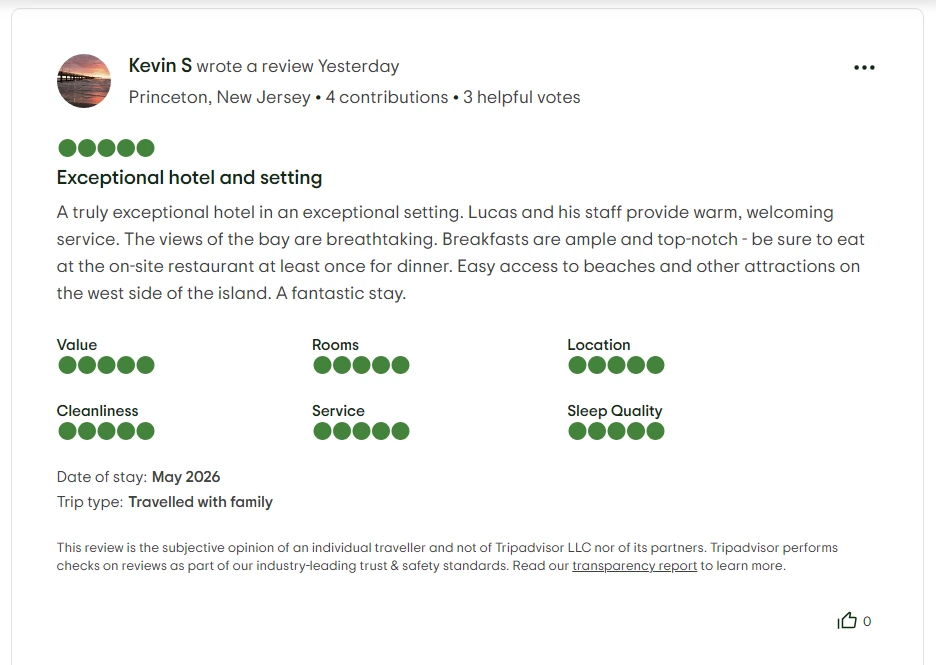
Tella Thera, Crete
Tella Thera is rated #1 on Tripadvisor with an Excellent overall score. Guests consistently highlight the warm service and on-site restaurant.
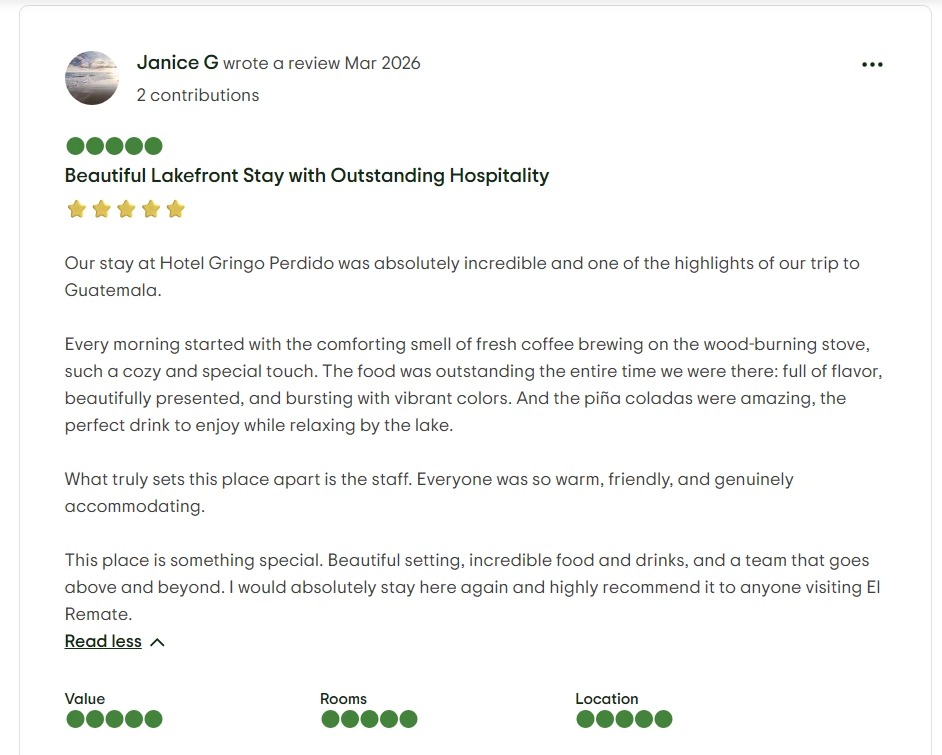
Hotel Gringo Perdido, Guatemala
Hotel Gringo Perdido has received the Certificate of Excellence multiple times on Tripadvisor. Guests point to its extensive amenities and relaxing spaces.
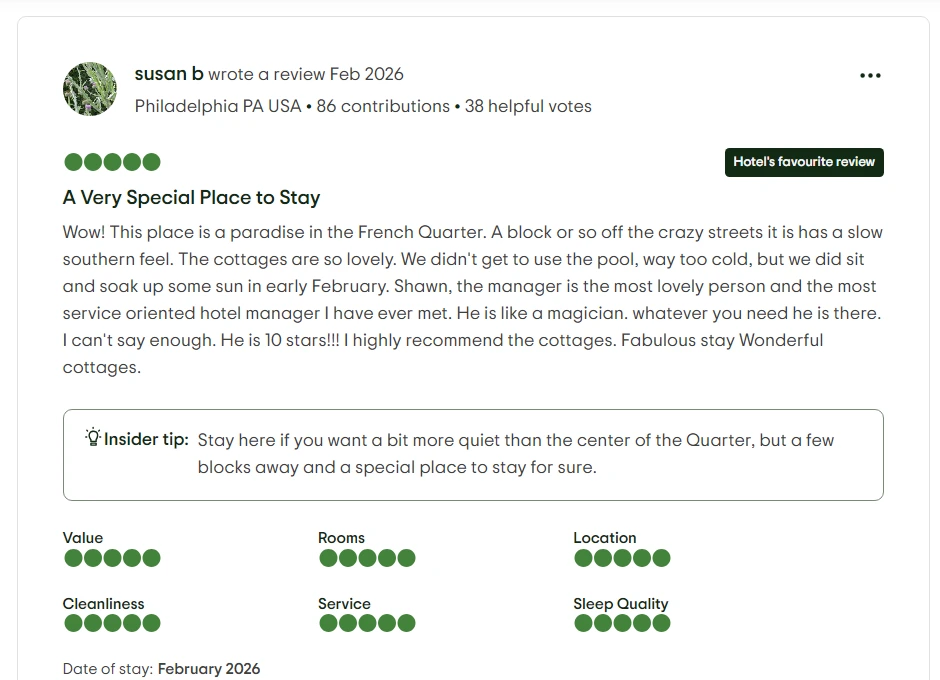
Audubon Cottages [J Collection], United States
Ranked the #5 best hotel in New Orleans on Tripadvisor, Audubon Cottages (part of the J Collection) is cited for its amazing customer service and ability to satisfy guest needs.
Catch issues before they’re reviews.
With Cloudbeds, send check-ins, collect feedback, and automate review requests.
6 ways to measure guest satisfaction
Gathering customer satisfaction data reveals how well your property meets and exceeds guest expectations and gives you the intelligence to improve. Here are the six most effective methods.
1. Online reviews
More than 40% of travelers leave an online review after a positive experience, and 48% do so after a negative one. Both are invaluable data sources as positive reviews reveal your strengths and negative ones reveal your gaps.
40%
leave reviews after positive experiences
48%
leave reviews after negative experiences
Monitor every platform where your property appears: Google, TripAdvisor, Booking.com, Expedia, Airbnb. Set up alerts so nothing slips past.
2. Guest satisfaction surveys
Surveys offer something online reviews don’t: control. You choose what you ask, when you ask it, and which part of the stay you probe. They can be deployed at multiple stages of the guest journey — pre-arrival, mid-stay, and post-stay — to build a complete picture of where satisfaction holds and where it breaks down.
The three most widely used survey metrics are:
| Metric | Question asked | What it measures | Best used for |
| CSAT (Customer Satisfaction Score) | “How would you rate your overall satisfaction with your stay?” (1–5 scale) | Snapshot satisfaction at a specific moment | Post-stay overall assessment |
| CES (Customer Effort Score) | “How easy was it to interact with [property name]?” (Very easy → Very difficult) | Friction in the guest experience | Check-in, checkout, request handling |
| NPS (Net Promoter Score) | “How likely are you to recommend us to a friend or colleague?” (0–10 scale) | Guest loyalty and advocacy potential | Long-term loyalty tracking |
Understanding your NPS
Guests who score 9–10 are Promoters — loyal advocates who generate referrals. Scores of 7–8 are Passives — satisfied but vulnerable to competitors. Scores of 0–6 are Detractors — at risk of leaving negative reviews. Your NPS is Promoters (%) minus Detractors (%). The average NPS for hotels is 49, with The Ritz-Carlton leading the industry at 66.
Add an open-ended follow-up question — “What one thing would have made your stay better?” — to convert scores into actionable insights rather than just numbers.
The volume and spread of online reviews today makes manual monitoring impractical for most properties. An online reputation management solution consolidates reviews from across platforms into a single dashboard, enabling real-time monitoring, sentiment analysis, competitor benchmarking, and response management at scale.
Cloudbeds Reputation Management automatically imports reviews from Booking.com, Expedia, Airbnb, Vrbo, Google, and more into a single unified dashboard with real-time notifications so your team can respond quickly regardless of where the review appeared. For multi-property operators, advanced filters let you slice reviews by property, channel, theme, or sentiment without losing the overview.
Where it goes beyond basic aggregation is in the AI-powered layer:
- AI-generated response drafts. When it’s time to respond, the tool drafts replies tailored to the specific review content, your brand tone, and preferred language.
- Sentiment analysis. Rather than relying on star ratings alone, Cloudbeds Reputation Management analyzes the actual language of each review to surface what guests are truly saying.
- Trend tracking. Monitor how sentiment is shifting across time periods and categories.
4. Website live chat and AI chatbots
Adding a chatbot to your hotel’s website is a two-way satisfaction investment. It helps travelers find the information they need in real time — which improves the booking experience and reduces friction — while generating data on what information gaps exist on your site.
What are travelers asking before they book? If the same questions keep appearing (parking, pet policies, check-in times, wi-fi), those gaps belong in your FAQ and website content. Closing them improves both the booking process and pre-arrival guest expectations.
Cloudbeds’ AI-powered assistant, built on the Signals AI foundation, takes this further by learning from your property’s own data (website, OTA listings, SOPs) to provide accurate, on-brand responses at any hour. The result is faster answers, better pre-arrival impressions, and fewer questions landing in your team’s inbox.
5. Social media listening
Social media is an unfiltered, real-time window into how guests feel about your property. Tools like Mention and Brandwatch let you monitor brand mentions across LinkedIn, Instagram, TikTok, and X, catching both tagged and untagged references to your property.
Beyond passive monitoring, social channels give hoteliers an active tool for gauging guest preferences. Polls and surveys (Instagram Stories, LinkedIn) can surface genuine input on future offerings, programming, or amenity decisions. A hotel polling its followers on what seasonal cocktail to add to the menu helps build the kind of participatory relationship that drives loyal guests and repeat bookings.
6. In-stay and post-stay messaging
The most time-sensitive guest satisfaction tool is the mid-stay check-in message. Sent a few hours after arrival or on the first evening of a multi-night stay, it creates an opportunity for real-time service recovery — catching issues while the guest is still on property and there’s still time to fix them.
Using guest messaging platforms like Cloudbeds Guest Experience, properties can automate mid-stay check-in messages and post-stay survey links across SMS, WhatsApp, and email without any manual triggering. Responses that flag a problem can be routed directly to the relevant department. Positive responses can be followed by an automated review request.
La Palmilla in Texas used automated post-stay messaging to build a post-checkout relationship that extended the guest experience beyond their stay:
I love that Cloudbeds has a tool to schedule emails for guests after they check out. Once a guest departs, they receive an email from us saying, ‘We hope you have a safe journey home. Here’s a playlist from your stay to remind you of us.’
This approach helped the property earn nearly 300 five-star Google reviews — not because they asked guests to leave them, but because they gave guests an experience worth talking about, then kept the connection alive after departure.
The service recovery framework
Dissatisfied guests will always exist. What separates high-satisfaction properties from average ones is how quickly and professionally those situations are resolved. Train your team on these six steps to service recovery:
- Listen — Give the guest your full attention without interrupting
- Clarify — Ask questions to fully understand the issue
- Empathize — Acknowledge how the situation made the guest feel
- Apologize — Offer a genuine, unconditional apology
- Resolve — Take action to fix the issue immediately, or explain clearly what will happen
- Follow up — Check back with the guest to confirm the situation was resolved to their satisfaction
A service recovery done well often results in a guest who is more loyal than one whose stay was problem-free. The act of having an issue handled with genuine care is itself a memorable experience.
How Cloudbeds helps hotels measure and improve guest satisfaction
Guest satisfaction measurement works best when it’s embedded in the same system your team uses to manage reservations, communication, and operations.
Cloudbeds integrates mid-stay check-in messages, post-stay survey delivery, review request automation, and reputation monitoring directly within the PMS. When a guest’s survey score falls below a threshold, a follow-up message can be triggered automatically, opening a private dialogue before the guest posts publicly. When a guest leaves a five-star score, a review request can follow within minutes.
The J Collection in New Orleans found that this connected approach changed how their entire team operated. As Chris Curry, Director of Revenue Management, explains:
Cloudbeds Guest Experience has really helped us with communicating with employees throughout the hotels and having the GMs able to use their phones to communicate with guests rather than be at the hotel. You’re accommodating the people that don’t want to speak to anybody and you’re accommodating the people that do want to speak to somebody, so all in all you’re just making every guest happy.
Guest satisfaction: An ongoing commitment
The importance of guest satisfaction only grows with time, as travelers have more options, more review platforms, and higher expectations shaped by every great stay they’ve ever had.
The properties that consistently lead on satisfaction share three habits: they collect feedback at multiple touchpoints throughout the guest journey, they respond to it consistently (both privately and publicly), and they use it to make real operational changes, not just to manage their online reputation.
Start by building the right templates, training programs, and feedback processes for your team. Decide which measurement methods fit your property and guest mix. Assign ownership for each initiative. And then review the data regularly, because the difference between a satisfied guest and a loyal one is almost always in the follow-through.
If this is done, hotels will not only have more satisfied guests, but also increase retention and word-of-mouth.
Key takeaways
- Guest satisfaction is a composite of every touchpoint in the guest journey.
- The three most effective survey metrics are CSAT (snapshot satisfaction), CES (friction measurement), and NPS (loyalty predictor).
- Mid-stay check-in messages are the most time-sensitive satisfaction tool.
- Service recovery done well can create loyalty stronger than an issue-free stay.
- Post-stay survey automation and review request sequencing are the most scalable way to generate review volume without manual effort.
- The most effective satisfaction systems are embedded in the PMS — not bolted on as a separate layer.
You can’t fix what you don’t know.
With Cloudbeds, catch issues in real time and automate review requests.