Before travelers book, they compare. Metasearch sites make it easy to view hotel rates side by side, helping travelers quickly find the best deal before they commit.
That comparison moment has become one of the most important stages in the booking journey. Travelers land on metasearch platforms after discovering a property through search, social media, online travel agencies, or recommendations, and then decide where to actually book.
If your direct rate and booking link aren’t visible there, OTAs like Booking.com and Expedia win the click and take 15–25% of the booking value for the privilege.
Hotel metasearch marketing helps hotels compete in that moment by putting their direct booking link alongside OTAs exactly when travelers are ready to make a decision. Done well, it drives high-intent traffic, reduces acquisition costs, and chips away at OTA dependency over time.
This guide covers everything hoteliers need to know about metasearch, including how metasearch engines work, where to advertise, how the bidding models compare, and how to build a metasearch strategy that drives more profitable direct bookings.
What is hotel metasearch?
Hotel metasearch engines are search platforms that aggregate hotel rates and availability from multiple booking channels — OTAs, direct hotel websites, and other intermediaries — and display them side by side.
Travelers use metasearch sites to compare hotel prices across channels without visiting each site individually. The most popular hotel metasearch platforms include Google Hotels, Tripadvisor, KAYAK, Trivago, and Skyscanner.
How metasearch engines work
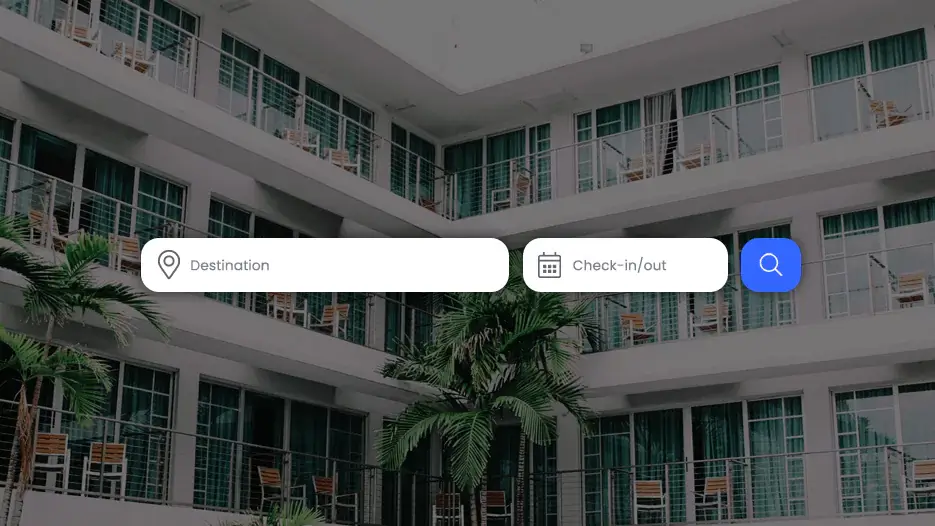
When a potential guest lands on a metasearch platform, they enter a destination and travel dates. The platform pulls real-time room rates and availability from connected booking channels and displays them in a ranked list. Click a hotel, and they see room types, rates from multiple sources, photos, and reviews, all without leaving the metasearch site.
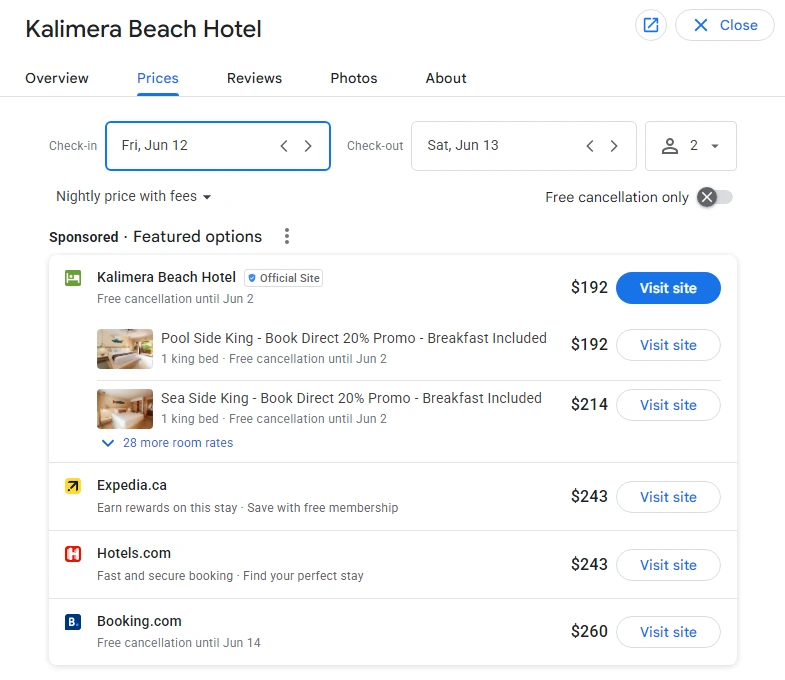
Here’s what most hoteliers miss: the order of those rates is not random. Metasearch platforms use a combination of algorithm signals, including bid amount, rate competitiveness, listing quality, and conversion history, to determine who appears at the top. The higher the placement, the more clicks. The more clicks, the more bookings.
Without a paid metasearch campaign, your direct booking link either doesn’t appear at all or gets buried beneath OTAs with more authority.
| OTAs | Metasearch |
| Who controls the booking? | OTA owns the transaction | The guest chooses where to book |
| Revenue model | Commission (15–25% of booking value) | CPC (cost-per-click) or CPA (cost-per-acquisition) |
| Guest data | OTA keeps it | Yours when they book direct |
| Rate displayed | OTA rate only | All connected channels side by side |
| Upsell capability | Limited or none | Full control when they land on your site |
| Direct relationship | No | Yes — if you capture the click |
The fundamental difference: OTAs compete for the booking. Metasearch gives you a seat at the table.
How hotel metasearch advertising works
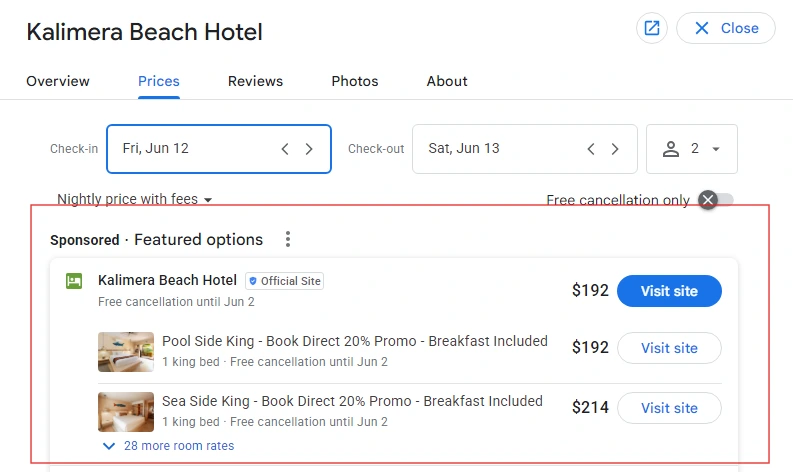
Simply being listed on metasearch platforms isn’t enough since most metasearch sites prioritize paid placements in their ranking algorithms. When hotels invest in metasearch advertising (also called metasearch marketing), their direct booking link appears prominently in sponsored ad spaces alongside OTAs, often with an “Official Site” badge that signals credibility to price-conscious travelers.
Metasearch ads puts your direct rate and availability right up against your OTA competitors and helps you get a lot more visibility.
The two bidding models: CPC vs. CPA
Depending on the platform, here are the two most common bidding models.
1. Cost-per-click (CPC / pay-per-click / PPC)
The hotel bids for ad placement and pays a fee for every click that drives a potential guest to its booking engine. The bid sets a maximum CPC; other factors — rate competitiveness, listing quality, landing page experience — also influence ranking.
Advantages include:
- Lower cost per transaction than OTA commissions
- You pay for traffic, not bookings (useful for high-conversion properties)
- More control and flexibility over daily and campaign budgets
- Higher return on ad spend when conversion rates are strong
2. Cost-per-acquisition (CPA / pay-per-stay)
The hotel pays a commission percentage on completed bookings, similar to the OTA model but typically at a lower rate. CPA reduces financial risk for properties still building their conversion infrastructure, though the hotel still pays whether the guest cancels or not.
Important: Google phased out commission-based bidding
As of April 2024, hotels can no longer start new campaigns on Google Hotel Ads using the commission model. Google transitioned to CPC and Performance Max for Travel Goals as the primary bidding strategies. Hotels running legacy commission-based structures can still access historical data, but new campaigns require CPC.
This shift is a net positive for hotels since CPC fees are structurally lower than OTA commissions, and properties with strong direct booking pages see meaningfully better ROI.
Benefits of metasearch marketing for hotels
Hoteliers often ask: “Why advertise on metasearch if I already have free booking links?” The answer is reach, position, and competitive necessity.
For starters, 94% of travelers start their accommodation search on metasearch. So if you’re relying only on organic search or OTA presence, you’re invisible at the most critical decision point in the guest journey.
94%
of travelers start their search on metasearch
Metasearch marketing also helps hotels:
Compete with OTAs on a level playing field
OTAs spend millions driving traffic away from your site. A metasearch campaign lets even a 10-room boutique hotel appear above Booking.com for its own property name.
Drive high-intent traffic
Metasearch ads are only triggered when a guest searches your destination on their actual travel dates, meaning every click comes from someone actively planning a trip. The quality of this traffic far exceeds most other digital channels.
Reduce cost per acquisition
OTA commissions run 15–25% of booking value. CPC metasearch fees, when managed well, cost a fraction of that. The math on direct bookings compounds over time, so every booking you reclaim from an OTA improves your net RevPAR.
Own the guest relationship
A guest who books direct gives you their contact information, their preferences, and an ongoing relationship. That’s future email marketing, loyalty, upsells, and repeat stays, none of which are available to you when the OTA owns the transaction.
Capture upsell and cross-sell opportunities
When a guest lands on your booking engine, you control the experience. That means promoting room upgrades, packages, F&B, spa, and late checkout.
Diversify your distribution strategy
Overreliance on any single channel is a revenue risk. Metasearch is a healthy addition to a mix that includes direct bookings, OTAs, GDS, and other channels — but one that actively routes guests toward your most profitable channel.
Easy to launch and manage
Compared to channels like social media advertising or SEO, metasearch is relatively straightforward to maintain. Campaigns are driven primarily by rates, availability, and bidding strategy rather than constant creative production.
With the right connectivity partner and booking engine in place, many hotels can launch campaigns quickly and manage performance from a single dashboard
Ready to cut your OTA dependency?
Learn how to make metasearch marketing your secret weapon this year.
The top hotel metasearch platforms in 2026
| Platform | Best for | Key advantage | Notes |
| Google Hotel Ads | All property types | Largest reach and strongest booking intent | Foundation of most metasearch strategies. |
| Tripadvisor | Hotels with strong reviews | Combines reviews and booking comparison in one experience | Strong trust signals; particularly influential in North America, Europe, and Australia |
| Trivago | Budget and midscale hotels | Strong visibility among price-sensitive travelers | Offers both CPC and CPA bidding models |
| KAYAK | Boutique and upscale hotels | Affluent, travel-savvy audience | Particularly strong in North America and Western Europe |
| Skyscanner | Resorts and gateway cities | Strong flight-to-hotel discovery behavior | Effective for travelers planning trips around airfare |
| Wego | APAC and MENA properties | Dominant presence across Asia Pacific and Middle East markets | Important regional channel for international visibility |
| HotelsCombined | Global distribution visibility | Broad international reach | Useful supporting channel outside primary markets |
| Hopper | Younger, deal-focused travelers | Price prediction and app-first audience | Strong with Millennial and Gen Z travelers |
1. Google Hotels
Google is the undisputed metasearch leader and should be the foundation of any metasearch strategy. Google Hotel Ads appear across Google Search, Maps, and Google My Business profiles, meaning your property can surface before a traveler even decides to visit a dedicated travel site.
According to Skift, Google accounts for 67% of all metasearch ad spend globally, and its expansion of Performance Max for Travel Goals gives hotels an AI-powered option that optimizes bids across Google’s full ad network in a single campaign.
One often-overlooked advantage: Google Free Booking Links. Google offers zero-commission organic placement in Hotel Search for properties connected through a qualifying channel manager or booking engine. These free links appear alongside paid ads and generate direct booking traffic at no cost per click. Every hotel should claim this.
Best for: All property types — prioritize this above any other metasearch channel.
2. Tripadvisor
Launched in 2000, Tripadvisor is one of the original metasearch platforms and remains one of the most influential travel sites in the world. Its dual role as review platform and booking comparison site makes it uniquely powerful since travelers use it to research and then book in the same session.
Tripadvisor offers CPC advertising via its TripConnect program and Sponsored Placements for increased visibility. Its review ecosystem is a major trust signal; properties with strong Tripadvisor ratings convert at higher rates across all booking channels.
Interestingly, Tripadvisor is also becoming increasingly important in the age of AI search. Cloudbeds’ AI visibility research found Tripadvisor to be one of the most commonly cited sources in AI-generated hotel recommendations, reinforcing its growing influence in how travelers discover hotels through generative AI platforms.
Best for: Properties with strong review profiles; markets where Tripadvisor has high organic search presence (Europe, North America, Australia).
6% of citations.
Community forums like Tripadvisor were cited frequently in hotel AI recommendations.
3. Trivago
Purchased by Expedia Group in 2012, Trivago works with more than 180 OTAs and booking sites worldwide. It offers both CPC and CPA bidding models, giving hotels flexibility based on their cash flow and conversion confidence.
Best for: Budget to midscale properties; price-competitive markets; European markets where Trivago has strong brand recognition.
4. KAYAK
One of the original metasearch channels (launched 2004, acquired by Booking Holdings in 2013), KAYAK operates across seven brands, including HotelsCombined, and covers more than 60 international sites. KAYAK attracts a more affluent, travel-savvy audience and is particularly strong in North America and Western Europe. Its parent company relationship with Booking Holdings means OTA coverage is deep, making it important to have your direct rate in the mix.
Best for: Upscale and boutique properties; North American and European markets; travelers who value price transparency.
5. Skyscanner
Founded in 2003 and acquired by Trip.com Holdings in 2016, Skyscanner reaches 100 million users per month across 52 markets in 30+ languages. Its strength is in flight search, which drives hotel discovery for travelers who start their trip planning with flights. Properties in key gateway cities and resort destinations benefit most from Skyscanner’s audience.
Best for: Resort destinations; city-center properties near major airports; APAC-focused properties.
6. Wego
Wego is the dominant metasearch platform across the Asia Pacific and MENA (Middle East and North Africa) regions and is the #1 travel app for iOS and Android in multiple markets. Operating across 76 countries in 22 languages, Wego aggregates hotel prices from 700+ travel sites. For properties in or targeting these regions, Wego is a mandatory channel.
Best for: Properties in APAC, Southeast Asia, and MENA; hotels targeting the luxury and business travel segments in these regions.
7. HotelsCombined
Acquired by Booking Holdings in 2018, HotelsCombined reaches 17 million users monthly across 220+ countries in 42 languages. Its strength is breadth of coverage and strong integration with Booking Holdings’ technology stack. For global distribution coverage, it’s a useful complement to primary channels.
Best for: Global coverage and price comparison visibility; supporting markets outside your primary channel focus.
8. Hopper
Founded in 2007, Hopper built its reputation on price prediction algorithms that help travelers find the best deals on flights, hotels, and car rentals. Its audience is particularly data-driven and deal-focused. Hopper expanded to include hotel bookings in 2017 and has grown steadily, particularly with younger travelers who prefer app-based travel planning.
Best for: Properties with strong value positioning; markets with high millennial and Gen Z traveler concentration.
7 metasearch strategies that drive real results
To maximize your return on investment in hotel metasearch marketing, consider the following strategies:
1. Ensure your direct rate is competitive
This is the foundation. If OTAs are displaying lower rates than your direct link, no metasearch campaign will save you, since travelers will click the cheaper option every time. Maintain genuine rate parity across channels, and where possible, offer direct-booking exclusives (flexible cancellation, room upgrades, early check-in) that tip the value equation in your favor even at the same rate.
2. Start with Google, then layer in other channels
Google should be your first metasearch investment as it has the highest reach and increasingly dominates how travelers discover hotels. Once Google is running profitably, expand to Tripadvisor, Trivago, or KAYAK based on your target markets.
3. Claim your free Google Booking Links
Before spending a dollar on CPC, claim your free Google Booking Links. These zero-commission placements appear in Google Hotel Search alongside paid ads and deliver direct booking traffic at no cost per click. They require connectivity through a qualified partner (like Cloudbeds), but the setup is worth it since every free click is a booking that costs you nothing.
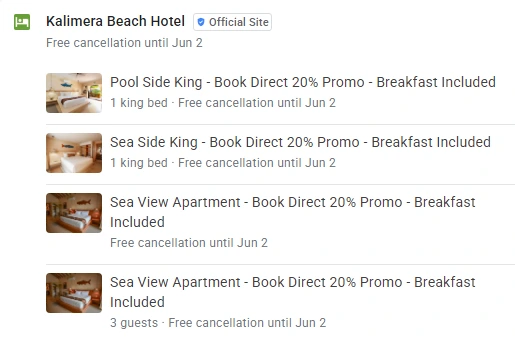
4. Diversify your rate offerings
Don’t advertise only your lowest available rate. Offer multiple room types and rate plans like flexible vs. non-refundable, breakfast included, and room-only to capture a wider range of intent. A traveler who wants cancellation flexibility won’t book a non-refundable rate; show them both and let them choose.
5. Optimize your listing quality
Metasearch algorithms factor in listing quality alongside bid amounts. Complete, high-quality listings with updated photos, accurate amenity information, and current policies perform better organically and convert better when paid traffic lands on them.
6. Manage your reputation actively
Many metasearch platforms aggregate and display review scores prominently. A lower star rating suppresses clicks regardless of how competitive your rate is. Build reputation management into your metasearch strategy and be sure to monitor and respond to reviews on Tripadvisor, Google, and other platforms.
Manage reviews from one place.
See how Cloudbeds consolidates reviews so you can easily monitor & respond from one spot.
7. Monitor, attribute, and adjust
Track performance at the channel level: clicks, conversion rate, cost per acquisition, and actual revenue generated. Attribution matters as a direct booking influenced by a metasearch click is worth more than it appears if you’re only looking at last-touch attribution. Use your performance data to shift budget toward channels that drive profitable bookings, not just clicks.
What you need to get metasearch right
Here are a few things to have in place to get started with metasearch marketing.
1. A booking engine that converts
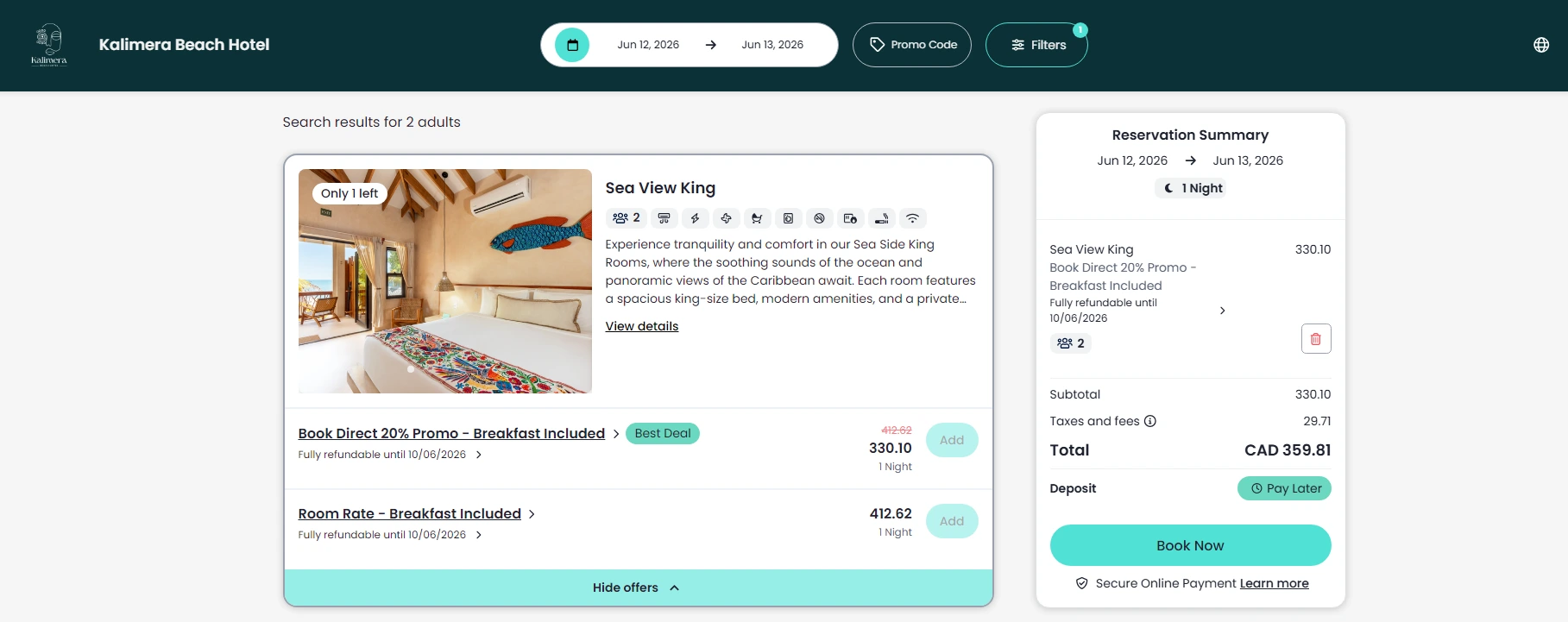
Your booking engine is the destination for every metasearch click. If it’s slow, hard to navigate, or lacks mobile optimization, you’re paying for traffic that bounces back to OTAs. Look for a booking engine that offers a 2-step checkout on any device, real-time rate display, and embedded payment processing.
Real-time rate and availability syndication is non-negotiable. If your rates on metasearch are outdated or inconsistent with what’s actually available, you’ll generate wasted clicks, guest complaints, and ranking penalties. A channel manager connected to all your distribution platforms keeps everything in sync automatically.
3. A connectivity partner with metasearch relationships
Most metasearch platforms require hotels to work through qualified connectivity partners rather than connecting directly. A connectivity partner manages the technical integration between your PMS or channel manager and the metasearch platform, handling rate feeds, availability data, and campaign infrastructure. Choosing the right partner determines which channels you can access and how efficiently you can manage campaigns.
4. A unified performance dashboard
Running metasearch campaigns across multiple channels generates a lot of data. Without a centralized view of impressions, clicks, conversions, and revenue by channel, you’re flying blind. A unified dashboard lets you compare performance across platforms in one place and see how metasearch ad spend translates into actual reservations.
How Cloudbeds powers metasearch for hotels
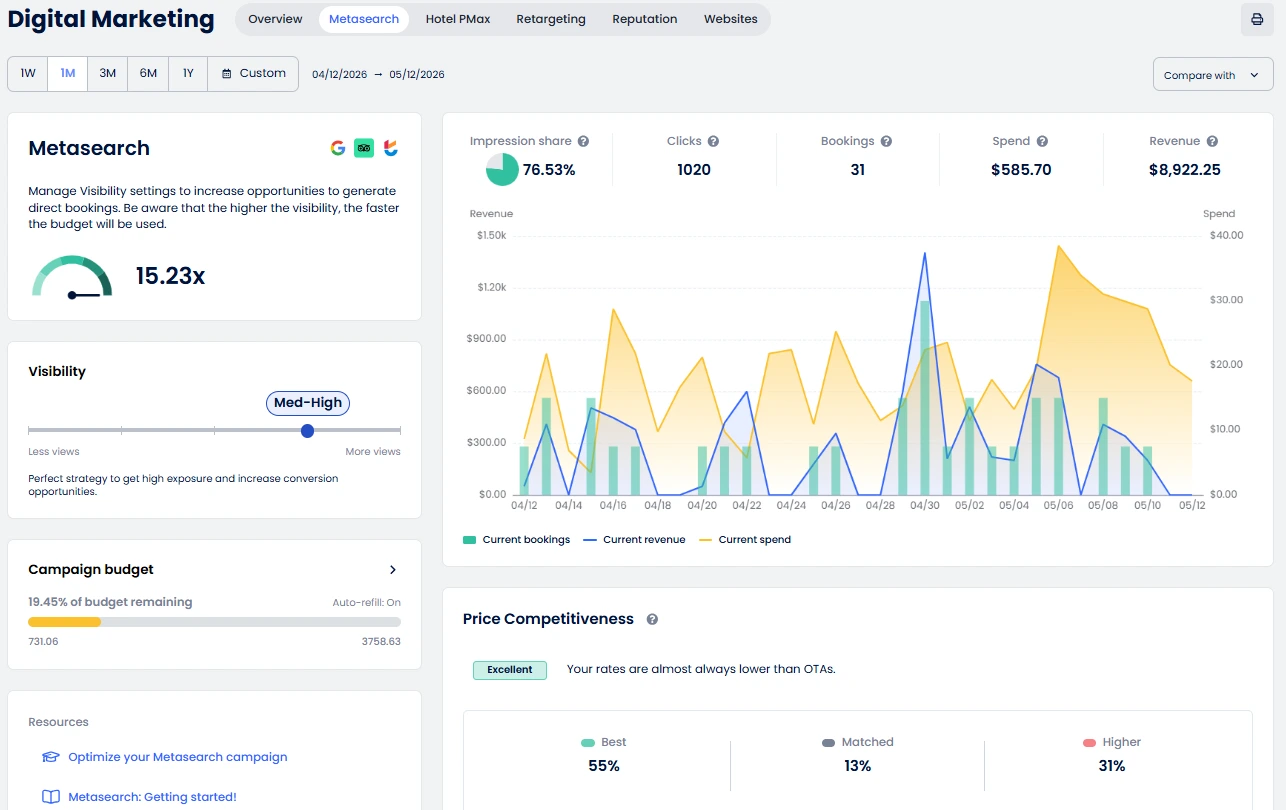
Running metasearch campaigns across multiple channels can quickly become difficult to manage. Cloudbeds Digital Marketing brings campaign management, rate connectivity, booking attribution, and performance tracking into one unified platform connected directly to your PMS and booking engine.
Because rates, availability, and reservation data all live in the same system, hotels can launch campaigns faster, monitor performance in real time, and optimize visibility without disconnected dashboards or manual reporting.
| What hotels need for metasearch | How Cloudbeds supports it |
| Fast campaign setup | Hotels can launch metasearch campaigns directly from Cloudbeds in the Digital Marketing dashboard in just a few steps, including budget selection, visibility settings, and automated credit refills. |
| Centralized campaign management | Metasearch campaigns are managed from a dedicated dashboard with performance tracking across clicks, bookings, spend, revenue, and impression share. |
| Visibility controls | Hotels can choose low, medium, or high visibility strategies depending on whether the goal is maximizing ROI or increasing booking volume. |
| AI-powered optimization | The platform automatically surfaces optimization suggestions and alerts when opportunities exist to increase visibility, bookings, or performance. |
| Budget management | Hotels can top up ad credits anytime and enable auto-refill to keep campaigns running without interruption. |
| Price competitiveness tracking | The Price Competitiveness dashboard compares direct rates against OTA rates across countries and dates, helping hotels spot parity issues quickly. |
| Real-time performance insights | Hotels can drill into country-level metrics, competitiveness trends, booking performance, and campaign results over time. |
| Integrated booking attribution | Because the platform connects directly to the PMS and booking engine, hotels can track actual reservations and revenue generated from metasearch campaigns. |
| Continuous optimization | Impression share metrics help hotels understand how often ads appear versus missed opportunities, making it easier to adjust strategy over time. |
Key takeaways
- Metasearch is where travelers compare prices before booking and where independent hotels can win back direct revenue from OTAs.
- Metasearch marketing is more cost-effective than paying OTA commissions.
- If your direct rate isn’t visible on metasearch platforms, OTAs will almost always win the booking.
- Metasearch marketing helps hotels turn high-intent travelers into more profitable direct bookings.
- The hotels winning on metasearch aren’t always spending more; they’re showing up with the right hotel room rates, visibility, and booking experience.
- Metasearch sits at the center of the modern booking journey, where travelers compare rates, evaluate options, and decide where to book.
- A strong metasearch strategy builds a more profitable direct booking channel over time.
- Metasearch has become one of the most important marketing strategies, putting direct booking links head-to-head with OTAs.
Create, fund, and manage campaigns.
See how Cloudbeds can help you boost direct bookings with just a few clicks.