
Guest feedback is prevention. Catch issues early, save your reputation, and turn near-misses into five-star moments.
If guests don’t surface issues during or after their stay, you may never know those issues exist, and you certainly can’t fix what you don’t know about. A proactive, organized approach to collecting, managing, and acting on hotel guest feedback is one of the most effective things a hotelier can do to protect and grow their revenue.
This guide covers what guest feedback is, why it matters, six steps to managing it effectively, proven collection strategies, and the tools that make the whole process scalable.
What is hotel guest feedback?
Hotel guest feedback is any information — impressions, suggestions, complaints, compliments — that guests share about their experience at your property. It spans everything from a verbal comment at the front desk to a detailed post-stay survey to a three-paragraph TripAdvisor review, and it covers the full arc of the hotel guest experience: from the booking process and check-in through the stay itself to post-stay follow-up.
Guest feedback is one of the most reliable indicators of guest satisfaction and loyalty. For this reason, it’s actively solicited by smart hoteliers and closely tracked as a key performance indicator for guiding improvements. Most feedback arrives through two channels:
- Direct feedback — in-person comments, front desk conversations, and post-stay surveys sent by the property
- Indirect feedback — public online reviews on TripAdvisor, Google, Booking.com, Expedia, Airbnb, and social media
Both provide valuable, if different, kinds of insight.
Why is guest feedback important?
Guests with positive experiences are more likely to become loyal guests and public advocates. Guests with negative experiences are more likely to leave bad reviews and book elsewhere next time. Guest feedback is the mechanism that helps you tell the difference and act on it before the damage is done.
The business stakes are real. Tripadvisor found 81% of travelers read online reviews before making a booking decision. The converse is equally true: negative reviews that go unaddressed — or aren’t surfaced at all because no one asked — compound over time and erode both reputation and revenue.
For independent hotels, the feedback loop is a genuine competitive advantage over chain hotels. When a boutique property receives a complaint, it can investigate and adapt in days, whereas a large brand may take months.
81%
of travelers read reviews before booking
How hotels use guest feedback
Guest feedback serves two distinct purposes in the hospitality industry: operational improvement and marketing.
For hotel operations, feedback reveals guest sentiment, identifies service gaps, and indicates what your team is doing well. Positive feedback helps you recognize team members who deserve it and understand which strengths to double down on. Negative feedback guides staff training needs, flags standard operating procedure gaps, and prioritizes property upgrades.
As a marketing tool, authentic hotel reviews are among the most persuasive content available. Positive reviews can be highlighted in email marketing campaigns, featured on your website, referenced in OTA listings, and shared on social media, providing social proof that no paid ad can replicate.
Quantitative vs. qualitative feedback
| Quantitative feedback | Qualitative feedback |
|---|
| Structured and measurable | Descriptive and contextual |
| Typically collected through ratings, scores, and surveys | Typically collected through written comments, reviews, and conversations |
| Easy to benchmark and track over time | Harder to measure, but often more actionable |
| Helps identify trends at scale | Helps explain why guests feel a certain way |
| Useful for KPIs like NPS, CSAT, and review scores | Useful for uncovering operational issues and guest frustrations |
| Example: “4 out of 5 stars” | Example: “The room was clean but the shower pressure was terrible” |
| Best for measuring performance | Best for identifying opportunities for improvement |
| Often summarized in dashboards and reports | Often requires manual review or AI-powered sentiment analysis |
Both types matter, and both serve different purposes.
Quantitative feedback is structured and measurable — a star rating on a review site, an NPS score, a 1–5 response to an online survey question. These numbers can be tracked over time, benchmarked against competitors, and used to measure progress objectively.
Qualitative feedback is descriptive and contextual — the freeform comment a guest leaves after giving a score, the paragraph in a TripAdvisor review that explains exactly why they rated cleanliness a 3. Harder to measure, but often where the most actionable insights live. A guest who writes “the room was clean but the shower pressure was terrible” has just given your maintenance team a to-do item that no rating scale could surface.
Online reviews vs. guest surveys
Both are essential; they serve different functions.
Guest surveys give hoteliers control. You choose what to ask, who receives the survey, and when it’s sent. Because responses come directly to you, you know who the guest is and can address issues privately before they go public. Surveys are especially powerful for in-stay feedback collection, where real-time service recovery is still possible.
Online reviews are public and owned by the platform. Hoteliers don’t control the questions, and reviewers are often anonymous. But they carry enormous influence — travelers read an average of nine reviews before booking, and they focus on the most recent ones.
The smart approach: use surveys to catch issues early and collect in-depth feedback on your own terms; use online review management to protect your public reputation and leverage positive guest sentiment in your marketing.
Ways to collect hotel guest feedback
The most effective feedback strategies in the hotel industry use multiple collection methods across the guest journey, not just a single post-stay email that most guests never open.
| Method | Best stage | What it captures |
| In-person / front desk | Arrival, in-stay, departure | Immediate sentiment; issues while staff can still respond |
| SMS / text message | In-stay, post-stay | High open rates; great for mid-stay check-ins and review requests |
| Email survey | Post-stay | In-depth feedback; structured questionnaires; NPS tracking |
| QR codes | In-stay (room, restaurant, lobby) | Self-service; low friction; captures in-the-moment feedback |
| Kiosk | Departure | Captures guests in transition; good for quick satisfaction scores |
| Online review platforms | Post-stay (organic) | Public sentiment; influences future bookings |
| Social media | Any | Unfiltered brand perception; identifies trends organically |
| Website live chat | Pre-booking | Pre-arrival concerns; common question patterns |
In-person feedback
Train staff members to notice signs of dissatisfaction and to create natural moments to invite feedback. A front desk team member who asks “Is there anything we can make better before your checkout tomorrow?” at the right moment can surface an issue that would otherwise end up in a public review.
Text message and SMS
SMS achieves 90% open rates within three minutes, far outperforming email for time-sensitive feedback collection. A mid-stay check-in text sent a few hours after arrival, or a post-stay review request sent within 24 hours of checkout, consistently generates higher response rates than email alone.
Cloudbeds supports automated text message delivery triggered by reservation status, so these messages go out at exactly the right moment without any manual work from your team.
QR codes
QR codes placed in rooms, at the restaurant, in the lobby, or at the pool give guests a frictionless, self-service path to share feedback on their own device at any point in the stay. They’re especially effective for capturing in-the-moment reactions, for example, a guest who loved their breakfast will be far more likely to scan a code at the table than to remember to write a review three days later.
Kiosk
A checkout kiosk in the lobby creates a natural moment to capture a quick satisfaction score as guests are departing.
With Cloudbeds, you can turn a tablet in the lobby into a self-service check-in, checkout, and feedback station — which makes real-time departing feedback collection practical even for lean teams.
Post-stay email surveys
For in-depth feedback collection, a well-crafted post-stay email survey remains the most comprehensive tool. Segment your outreach by guest type (first-time vs. returning, leisure vs. business), personalize the message, and keep the survey focused, using three to five well-chosen questions to generate better response rates and more actionable data than exhaustive questionnaires.
Cloudbeds automates post-stay survey delivery and review request sequences, triggered by departure date, guest segment, or satisfaction score. When a guest completes an in-stay survey with a low score, an automated follow-up can be triggered before the guest even checks out, opening a private channel for resolution before the issue goes public.
6 steps to managing guest feedback
To ensure that guest feedback receives the attention it deserves, it’s important to take an organized, systemic approach to feedback management.
1. Listen
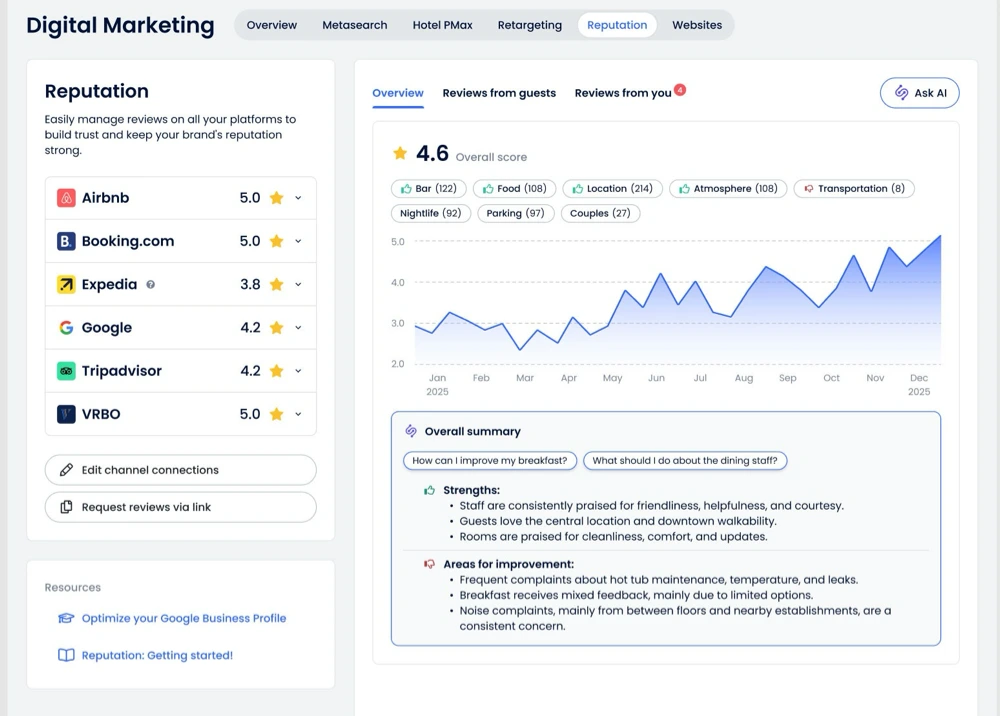
Put systems in place to ensure no feedback goes unnoticed. Set up real-time notifications for new reviews across TripAdvisor, Google, Booking.com, Expedia, and Airbnb. Configure automated alerts for survey submissions. Assign clear ownership so every piece of feedback is seen and actioned by the right person.
Cloudbeds Reputation Management automatically imports reviews from all connected distribution channels into a single unified dashboard, sending real-time notifications as reviews arrive.
2. Share
Feedback — positive and negative — belongs with the people who can act on it. Share relevant reviews and survey results with front desk staff, housekeeping supervisors, F&B managers, and department heads as part of regular team meetings. Use positive feedback to recognize team members publicly; use negative feedback as a constructive learning tool, not a blame exercise. Celebrating a rave review at a staff meeting is one of the most effective ways to reinforce the behaviors that generated it.
3. Take action
When feedback is negative, move quickly. Identify what went wrong, who was involved, and what process or training gap allowed it to happen. Then fix it — not just for the guest who reported it, but to prevent it for every guest who follows. Create clear ownership: who is responsible for following up on maintenance issues raised in reviews? Who updates SOP templates when a pattern emerges in survey data? Feedback without a follow-up process is just noise.
Patterns matter more than individual data points
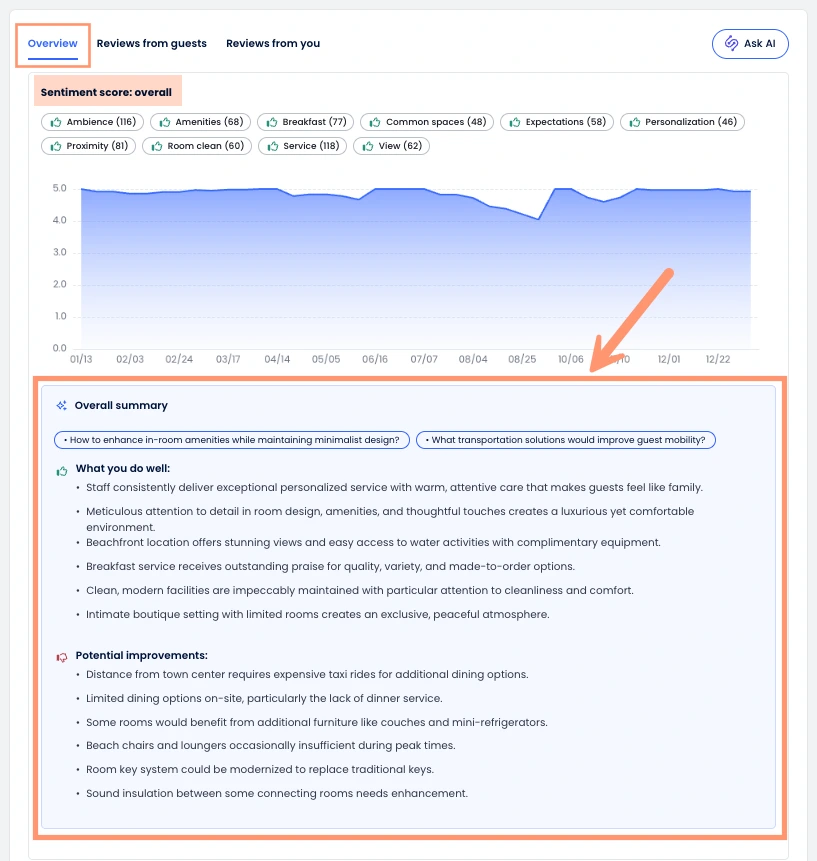
A single complaint about noise could be a one-off; five complaints in two weeks pointing to the same floor on weekend nights is an operational issue.
Cloudbeds’ sentiment analysis automatically detects recurring themes across all your reviews, categorizing feedback by topic and flagging trend shifts over time so you can spot systemic issues before they compound.
4. Respond
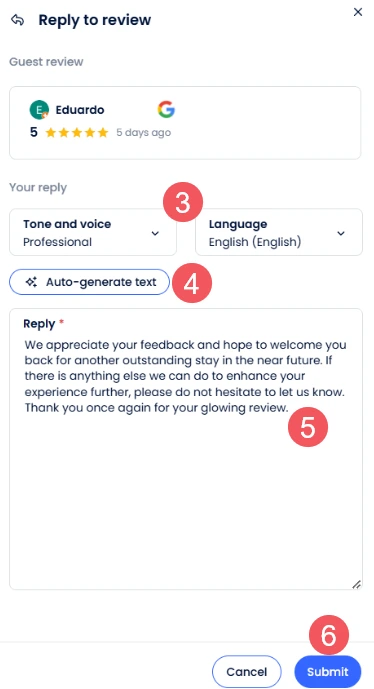
Every review deserves a response. 89% of travelers say that a thoughtful response to a negative review improved their impression of the property. Aim to respond to negative reviews within 24 hours, addressing specific comments rather than defaulting to generic apologies. Thank guests for positive feedback by name and reference something specific they mentioned.
Cloudbeds’ AI-generated response drafts match your brand tone and review content helping saving hours of manual writing while keeping responses specific and genuine.
89%
of travelers say a thoughtful response improved their impression
5. Measure
Set clear benchmarks and track them consistently: overall review score across platforms, departmental satisfaction ratings, Net Promoter Score, Tripadvisor ranking relative to your competitive set. Without baseline measurements, you can’t tell whether the changes you’re making are working.
6. Automate
The feedback process should run in the background, not rely on someone remembering to send a survey or log into five different platforms to check your online reputation. Automate what can be automated: mid-stay check-in messages, post-stay survey requests, review platform alerts, and review response drafts.
Cloudbeds handles automated guest communication across SMS, WhatsApp, and email — sending check-in messages, survey links, and review requests at the right moments in the guest journey, triggered by reservation data in the PMS (property management system).
Create lifelong fans.
See how to nurture guests and drive repeat revenue.
How Cloudbeds helps with guest feedback management
Managing hotel guest feedback effectively requires tools that work together. Here’s how Cloudbeds supports each stage of the feedback cycle.
Collect feedback throughout the stay
Cloudbeds Guest Experience powers automated mid-stay check-in messages via SMS, WhatsApp, and email — creating real-time feedback touchpoints throughout the guest’s stay without any manual triggering. The unified inbox consolidates responses across all channels so nothing goes unanswered.
Monitor, analyze, and respond at scale
Cloudbeds Reputation Management automatically imports reviews from Booking.com, Expedia, Airbnb, Vrbo, Google, and more into a single dashboard, with real-time notifications so your team can respond quickly.
The AI-powered sentiment analysis layer goes beyond star ratings to surface what guests are actually saying, automatically tagging and color-coding reviews as positive, neutral, or negative, detecting up to 10 dynamic recurring themes, and identifying top strengths alongside areas for improvement across your full review history.
AI-generated response drafts — tailored to the specific review content, your brand tone, and preferred language — make responding to every review fast, consistent, and genuinely personal.
And for multi-property groups, advanced filters let operators compare performance by property, channel, theme, or sentiment, benchmarking each location against the others and identifying where to focus operational attention.
Turn feedback into loyalty
Cloudbeds Guest Marketing CRM connects directly to your PMS, meaning every segmented email campaign is informed by real reservation data — stay history, booking channel, lifetime spend, departure date — without manual exports.
For feedback management, its most powerful applications are post-stay survey automation and review request sequencing. A post-stay message sent within 24 hours of checkout consistently improves both survey response rates and review volume. Guests who return low scores can be routed to a private resolution flow; guests who return high scores can be followed immediately with a review request.
Beyond feedback collection, the platform supports “we miss you” campaigns for guests who haven’t returned in 60–90 days, milestone-triggered loyalty offers, and flash sale campaigns for filling last-minute availability, turning satisfied guests into repeat bookers.
Intelligence on demand
Cloudbeds Signals is the AI foundation that runs across the platform, and Ask Signals makes it conversational. Instead of running reports, hotel management can ask natural-language questions — “What are the most common complaints in reviews from the last 30 days?”, “Which room types generate the most positive feedback?”, “How is our breakfast satisfaction trending compared to last quarter?” — and receive answers drawn in real time from across the platform’s connected data.
Key takeaways
- Hotel guest feedback is the mechanism that prevents guest issues from becoming public reputation damage.
- The most effective feedback strategies use multiple collection methods across the full guest journey: in-person conversations, mid-stay text messages, QR codes, kiosk capture at departure, post-stay email surveys, and online review monitoring.
- Quantitative feedback (star ratings, NPS, CSAT) tells you how you’re performing; qualitative feedback (open-ended survey responses, review text) tells you why.
- The six-step feedback management framework — Listen, Share, Take Action, Respond, Measure, Automate — provides a repeatable process.
- Patterns in feedback matter more than individual data points.
- Sentiment analysis tools that detect recurring themes across hundreds of reviews surface operational issues far faster than manual reading can.
- Guest data flowing from reservations into surveys, review requests, and marketing campaigns is what turns feedback management from a manual burden into an automated, continuous improvement loop.
- Authentic guest reviews featured on your website, in email campaigns, and across OTA listings provide social proof that consistently outperforms paid advertising.
You can’t fix what you don’t know.
With Cloudbeds, catch issues with real-time feedback collection and AI-powered sentiment analysis.



