The best distribution strategy doesn’t choose between online travel agencies and direct bookings. It uses both.
Online travel agencies are one of the most powerful distribution tools available to hotels when used with intention. They open your property to millions of travelers who might never find you otherwise, provide built-in infrastructure that would cost far more to replicate independently, and carry a level of consumer trust that takes years to build on your own.
Used strategically, OTAs can increase visibility, fill need periods, introduce your hotel to new markets, and even drive more direct bookings through the billboard effect. The key is understanding where they add value, where they come with trade-offs, and how to build a channel mix that supports long-term profitability instead of short-term occupancy.
8 real benefits of OTAs for hotels
From global visibility to built-in marketing and payment infrastructure, OTAs offer advantages that would be difficult—and expensive—for most hotels to recreate on their own.
1. Unmatched global reach and visibility
The balance of power remains firmly in the hands of travel intermediaries, especially OTAs, which account for 55% of online hotel bookings worldwide. For hotels, that’s an audience that’s simply too large to ignore.
55%
of worldwide bookings come from OTAs
No independent hotel marketing budget can match the global reach of platforms like Booking.com, Expedia, or Airbnb. They operate in dozens of languages, support local currencies and payment methods, rank prominently for destination searches, and attract millions of travelers every day.
That gives hotels the opportunity to reach guests from around the world who may never have discovered them otherwise. Whether you’re a boutique hotel in a secondary market or an urban property looking to expand into new international source markets, OTAs put your rooms in front of travelers at the exact moment they’re comparing where to stay.
Think of OTAs as a global sales force: helping your hotel reach new markets, build awareness, and generate bookings far beyond what most properties could achieve through direct channels alone.
2. Traveler trust and credibility
Travelers book where they feel safe. OTAs have spent decades building brand recognition and consumer trust through user-friendly interfaces, clear cancellation policies, verified reviews, and secure payments. For a first-time visitor researching your destination, seeing your property on Booking.com or Expedia lends it legitimacy that your own website — no matter how well designed — may not yet have.
This is especially relevant for newer properties or those entering a new market segment. Appearing on a trusted platform de-risks the booking decision for travelers who don’t yet know your brand.
3. Convenience for comparison-shopping travelers
Travelers use OTAs the same way they use Google: to research, compare, and filter down. They’re not necessarily loyal to any one OTA, but use the platform as a search engine for accommodations. The ability to filter by price, location, amenities, property type, and review score saves hours of research and creates a streamlined path to booking.
For hoteliers, this means your property gets surfaced at the exact moment a traveler is ready to make a decision — one of the highest-intent moments in the entire booking journey.
4. Loyalty programs that drive repeat OTA behavior
The major OTAs have invested heavily in loyalty programs that lock travelers into their ecosystems. Expedia Group’s One Key program lets travelers earn and redeem rewards across Expedia, Hotels.com, and Vrbo. Booking.com’s Genius program offers tiered discounts, free breakfasts, and room upgrades to frequent bookers.
These programs benefit participating properties by giving them preferential placement and conversion lift among loyalty members, a segment that tends to book more frequently and spend more per trip.
5. The billboard effect: OTAs drive direct bookings too
Here’s what often gets overlooked: OTA exposure generates direct bookings. Travelers who discover your property on Booking.com or Expedia frequently search your property name directly before booking, either to validate the listing or to find a better rate on your own site.
This is the billboard effect, and the research behind it is consistent. A traveler sees your property on an OTA, does a quick Google search for your hotel name, lands on your website, and books directly. Your OTA listing effectively becomes a marketing channel for your direct booking engine.
The implication: having a well-optimized, conversion-ready direct booking engine isn’t just about capturing OTA-resistant guests, but capturing the guests your OTA presence generates.
6. Price-driven discovery and deal-seeking behavior
OTAs have positioned themselves as the go-to destination for deal hunters. Platforms like Agoda, HotelTonight, and Booking.com regularly promote flash sales, last-minute deals, and package discounts that attract high-intent, price-sensitive travelers.
For properties with soft demand periods, OTA promotional tools (early bird rates, non-refundable discounts, package deals) can be a practical way to fill occupancy gaps without discounting your direct rate.
The important nuance: rate parity clauses vary by platform and market. Understanding what promotional flexibility you have on each OTA is part of building a sound distribution strategy.
7. Massive advertising and marketing infrastructure
The scale of OTA marketing spend is hard to overstate. Airbnb, Booking Holdings, Expedia Group, and Trip.com Group spent a combined $20 billion on sales and marketing in 2025, with Booking and Expedia alone accounting for more than three-quarters of that total.
$20B
OTAs spend on sales & marketing
That spend shows up everywhere: paid search, social media, TV advertising (Booking.com took a Super Bowl slot during the 2026 game), influencer partnerships, and brand campaigns. When you list your property on an OTA, you’re accessing distribution infrastructure built with billions of dollars in marketing investment.
Many OTAs also give hotels the opportunity to amplify their visibility through sponsored placements and cost-per-click advertising. These paid campaigns can boost your property’s ranking in search results during key booking periods, helping you capture more high-intent travelers.
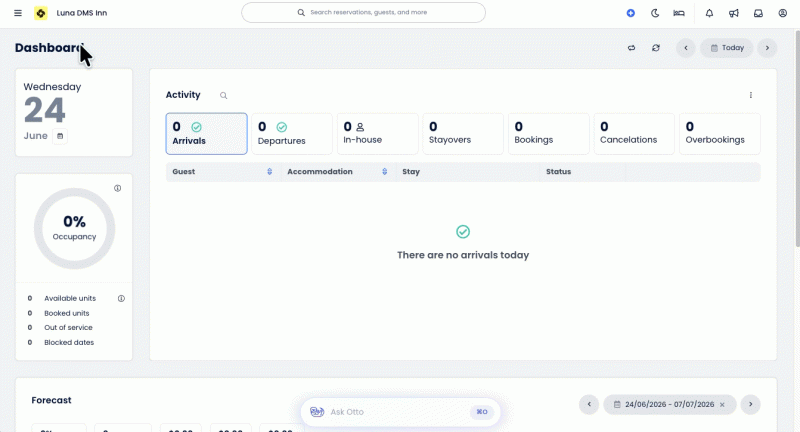
For hotels looking to manage these campaigns alongside Google Hotel Ads and other digital channels, Cloudbeds OTA Travel Ads makes it possible to launch and optimize OTA advertising directly from the Cloudbeds Digital Marketing Suite.
8. Secure payments and traveler protection
OTAs provide a layer of payment infrastructure and consumer protection that many hotels can’t easily replicate. They support multiple currencies, localized payment methods (buy-now-pay-later, digital wallets, local bank transfers), and offer traveler protection programs like Airbnb’s AirCover, which provides refunds and rebooking support for guests who experience issues.
For travelers booking internationally, this peace of mind is a genuine value driver that increases conversion. For properties, OTA payment processing means fewer payment failures, reduced currency risk, and a lower barrier to attracting international guests.
One note for independents: if you’re investing in your direct channel, having equally capable payment infrastructure on your own site matters. Cloudbeds Payments supports multiple currencies and payment methods, sends hospitality-enriched data to banks to reduce declines, and provides the kind of checkout experience travelers expect from a major OTA.
Making OTAs work harder for your property
The hotels that get the most from OTAs are the ones that treat them as the first chapter of the guest relationship, not the whole story. A traveler who books through Booking.com is still a guest you can impress, retain, and convert into a direct booker on their next visit.
That requires a channel management setup that’s actually connected: where your availability syncs in real time across every OTA you’re listed on, where a booking on one channel instantly closes inventory on all others, and where your rates stay consistent and competitive without manual intervention.
Cloudbeds connects to hundreds of distribution channels — including preferred partner relationships with Booking.com, Expedia, Agoda, and Airbnb — meaning your property gets deeper integration with the platforms driving the most volume. No extra commissions beyond what the OTA charges, and no overbooking risk from stale inventory.