Getting your hotel in front of the right travelers is only half the challenge. Turning that interest into bookings, building relationships with guests, and giving them a reason to return is where hotel marketing really earns its keep.
There’s no shortage of hotel marketing tools to help you do this. But with limited budgets and increasingly complex booking journeys, it’s important to understand which tools are worth investing in, where they fit into your marketing strategy, and how they contribute to revenue.
Here we explore the essential tools, from booking engines and email marketing platforms to SEO and digital advertising, and how to use them together to reduce acquisition costs and grow direct bookings.
Key takeaways
- Hotel marketing tools help properties attract travelers, convert interest into direct bookings, build guest loyalty, and measure marketing performance.
- A mobile-friendly website, booking engine, PMS, and channel manager form the foundation of an effective hotel marketing tech stack.
- Hotel email marketing and CRM tools use guest data to personalize campaigns, encourage repeat bookings, and reduce reliance on OTAs.
- SEO tools, Google Business Profile, and Google Analytics help hotels improve search visibility, understand traveler behavior, and track booking conversions.
- Metasearch advertising, Google Hotel Ads, and retargeting help hotels capture existing demand and compete with OTAs for direct bookings.
- Social media management, content creation, and reputation management tools help hotels reach new audiences, build credibility, and improve visibility across traditional and AI-powered search engines.
- The best hotel marketing tools connect with reservation and guest data, enabling hotels to automate campaigns and measure marketing performance against actual revenue.
Where hotel marketing tools fit into the guest journey
Hotel marketing rarely follows a linear path. A traveler might discover your property on Instagram, compare rates on Google, read reviews on Tripadvisor, and eventually book through your website. The relationship continues after checkout, when a well-timed email or personalized offer can turn a one-time visitor into a repeat guest.
Each hotel marketing tool serves a different purpose along that journey:
- Drive discovery: SEO tools, social media platforms, content creation tools, and local search
- Capture demand: Metasearch advertising, Google Hotel Ads, paid advertising, and retargeting
- Build trust: Online reviews, reputation management software, and user-generated content
- Convert interest into bookings: Hotel website, booking engine, PMS, and channel manager
- Grow guest lifetime value: CRM, email marketing, loyalty programs, and upselling tools
- Measure performance: Google Analytics, campaign reporting, and revenue attribution tools
While discovery is where the guest journey often begins, it’s not necessarily where your technology investment should start. Before spending more on attracting travelers, make sure you have the infrastructure in place to convert that interest into bookings.
The foundational tools
Before investing in marketing tools, make sure you have the core technology in place to support them. Even a well-executed marketing campaign can fall short if guests encounter a frustrating booking experience, rates and availability are inconsistent across channels, or your marketing team can’t access reliable guest data.
While the following systems aren’t all marketing tools in the traditional sense, they provide the infrastructure that makes your marketing efforts more effective.
| Tool type | What it does | What to look for |
| Property management system (PMS) | Centralizes guest, reservation, and stay data to support targeted marketing campaigns | Unified guest profiles, real-time data, marketing integrations |
| Hotel website | Showcases your property, attracts organic traffic, and drives direct bookings | Mobile-friendly design, fast loading speeds, SEO capabilities |
| Booking engine | Converts website visitors into direct bookings | Commission-free bookings, mobile-friendly checkout, promotional codes, customizable rate plans |
| Channel manager | Synchronizes rates and availability across direct and third-party booking channels | Real-time inventory updates, broad channel connectivity, centralized rate management |
Property management system (PMS)
Your property management system is the foundation of your hotel’s guest and reservation data. When marketing tools have access to this information, you can build more targeted campaigns based on actual stay history, personalize offers, and measure the revenue generated by your marketing efforts.
Hotel website
Your hotel website is the foundation of your direct booking strategy and one of the few marketing channels you have full control over. It should be fast, mobile-friendly, optimized for search, and designed to move visitors seamlessly from exploring your property to making a reservation.
Booking engine
A hotel booking engine allows guests to check real-time rates and availability and book directly through your website. Look for commission-free bookings, a streamlined mobile booking experience, and the flexibility to offer packages, promotional codes, and exclusive direct booking rates that support your marketing campaigns.
Channel manager
A channel manager keeps rates and availability synchronized across your distribution channels, including your direct booking engine and online travel agencies (OTAs). This gives you greater control over your distribution strategy and ensures that the demand your marketing campaigns generate can translate into bookable inventory.
With these systems in place and connected, you can focus on investing in marketing tools that attract the right travelers, grow direct bookings, and bring guests back.
SEO and analytics tools to improve hotel visibility
Once your direct booking infrastructure is in place, the next step is getting travelers to your website. Search engine optimization (SEO) helps hotels attract organic traffic without paying for every click, while analytics tools help you understand which marketing channels are actually generating bookings.
| Tool type | What it does | Example tools |
| Keyword research and SEO tools | Identify search opportunities, analyze competitors, and monitor organic search performance | Google Keyword Planner, Semrush, Ahrefs |
| Local SEO tools | Improve hotel visibility in location-based searches and map results | Google Business Profile |
| Website analytics and conversion tracking tools | Track website traffic, visitor behavior, booking conversions, and organic search performance | Google Analytics 4, Google Search Console |
| GEO and AI search monitoring tools | Track hotel visibility, brand mentions, and citations across AI-generated search results | Rankscale, Peec AI, Otterly.AI |
Keyword research tools help you understand what travelers are searching for when planning a trip, from broad searches like “boutique hotels in Savannah” to more specific queries around amenities, neighborhoods, and local experiences.
Google Keyword Planner is a free starting point, while platforms like Semrush and Ahrefs offer more advanced capabilities, including competitor analysis, keyword tracking, technical website audits, and content gap analysis.
Use these insights to inform your website content, identify opportunities to attract relevant traffic, and monitor your hotel’s organic search performance over time.
Local SEO and Google Business Profile
For hotels, visibility in location-based searches is particularly important. Google Business Profile is a free tool that helps your property appear in Google Search and Maps when travelers are exploring a destination.
Keep your property information, amenities, contact details, website links, and photos accurate and up to date. Regularly responding to reviews and maintaining consistent information across online directories also supports your local search presence.
Google Analytics 4 (GA4) helps hotels understand where website visitors come from, how they interact with the site, and which marketing channels contribute to bookings. Google Search Console complements this by showing which search queries drive organic traffic and identifying technical issues that may affect search visibility.
Connecting Google Analytics to your booking engine is particularly important, as it allows you to track the guest journey beyond the initial website visit and evaluate campaigns based on booking conversions and revenue rather than traffic alone.
Generative engine optimization (GEO) and AI search
Travelers are increasingly using AI platforms like ChatGPT and Gemini to research destinations, compare properties, and find hotel recommendations. Generative engine optimization (GEO) focuses on improving your property’s visibility within these AI-generated answers.
Our research into AI hotel recommendations found that a property’s wider digital footprint plays an important role in whether it appears in AI-generated recommendations.
Many of the tools and practices that support traditional SEO also support GEO, including accurate property listings, detailed website content, consistent information across third-party platforms, and a strong online reputation. AI search monitoring tools like Rankscale, Peec, and Otterly can also help hotels track how frequently their properties are mentioned and which sources AI platforms reference when making recommendations.
Get recommended by AI engines.
Read the full report to see what signals matter in AI recommendations.
Digital advertising tools
While SEO helps hotels build organic visibility over time, digital advertising tools allow you to reach travelers at specific points in their booking journey, from initial destination research to comparing rates and making a reservation.
| Tool type | What it does | Example tools |
| Metasearch advertising platforms | Display direct booking rates alongside OTA rates to capture high-intent travelers | Google Hotel Ads, Tripadvisor, Trivago, Kayak |
| Search and AI-powered advertising platforms | Run paid search, branded advertising, Performance Max, and retargeting campaigns | Google Ads |
| Social media advertising platforms | Reach new audiences, generate demand, and re-engage potential guests through paid social campaigns | Meta Ads Manager, TikTok Ads Manager |
| OTA advertising tools | Increase property visibility and booking opportunities within OTA search results | Expedia TravelAds, Booking.com Visibility Booster |
| Hotel-specific digital advertising software | Manage and optimize advertising across multiple channels and track performance against booking revenue | Cloudbeds Digital Marketing |
Metasearch engines such as Google, Tripadvisor, Trivago, and Kayak allow travelers to compare hotel rates from multiple booking sources in one place. Advertising on these platforms gives hotels the opportunity to display their direct booking rates alongside OTA rates, reaching travelers when they’re actively comparing their options.
Google Hotel Ads is particularly valuable because it reaches travelers across Google Search, Maps, and Travel. Hotels can also take advantage of Google’s free booking links to display their direct rates without paying for ad placements.
Metasearch advertising requires a connection to your hotel’s live rates and availability, typically through a connectivity or digital advertising partner.
Google Ads
Google Ads allows hotels to run several types of advertising campaigns from a single platform, with automated bidding, audience targeting, and conversion tracking capabilities.
Three particularly relevant campaign strategies for hotels include:
- Paid search: Reach travelers searching for accommodation in your destination or specific property features, and protect direct bookings by bidding on your hotel’s brand name.
- Performance Max for travel goals (Hotel PMax): Use Google’s AI to optimize bidding and distribute ads across Search, YouTube, Display, Maps, Gmail, and Discover based on booking conversion goals.
- Retargeting: Re-engage travelers who have visited your website but haven’t completed a reservation, bringing them back to your direct booking engine.
Branded search campaigns are particularly important for hotels competing with OTAs that bid on their property’s name.
When a guest searches your hotel name, they’ve already chosen you. That’s a very high-intent moment to book.
Without a branded search strategy, hotels risk paying an OTA commission for a guest who was already looking specifically for their property.
Meta Ads Manager and TikTok Ads Manager allow hotels to reach potential guests through paid social media campaigns based on factors such as location, interests, and online behavior.
Unlike metasearch, where travelers are actively comparing hotel rates, social media advertising can introduce your property to people who haven’t yet decided where to stay or even started planning a trip.
These platforms also support retargeting campaigns that reconnect with previous website visitors, helping hotels stay visible throughout the booking journey.
Online travel agencies (OTAs) offer their own advertising and promotional tools to help hotels increase visibility within their search results. Expedia TravelAds offers sponsored placements, while Booking.com’s Visibility Booster allows properties to increase their visibility in exchange for a higher commission.
These tools can be particularly useful when launching a new property, targeting new markets, or filling rooms during periods of lower demand.
When evaluating OTA advertising performance, factor in both advertising costs and booking commissions to understand the true cost of acquiring each reservation and how it compares with your direct booking campaigns.
Hotel-specific digital advertising software
Managing advertising across multiple platforms requires time, expertise, and reliable conversion data. Hotel-specific digital advertising software simplifies this process by connecting campaigns with hotel rates, availability, and booking data.
For example, Cloudbeds Digital Marketing helps hotels manage and optimize metasearch, Hotel PMax, OTA advertising, and retargeting campaigns, with performance reporting that shows how advertising spend translates into booking revenue.
Social media and content creation tools
Social media plays an increasingly important role in hotel discovery. TravelBoom’s 2026 Leisure Travel Study of 500 US leisure travelers found that social media influenced 55% of respondents, up 16 percentage points from the previous year.
For hotels with limited marketing resources, the right tools can make it easier to maintain an active social media presence.
| Tool type | What it does | Example tools |
| Social media management tools | Schedule content, manage engagement, monitor conversations, and track social media performance | Hootsuite, Sprout Social, Sendible, Later |
| Graphic design and video editing tools | Create branded graphics, promotional materials, and short-form videos | Canva, Adobe Express, CapCut |
| AI content creation tools | Generate campaign ideas, draft marketing copy, and repurpose content across channels | ChatGPT, Claude, Gemini |
| Influencer marketing tools | Discover creators, manage partnerships, and measure campaign performance | Upfluence, CreatorIQ |
| User-generated content tools | Discover, collect, manage usage rights, and repurpose guest-created content | CrowdRiff, TINT |
Social media management tools
Platforms like Hootsuite, Sprout Social, Sendible, and Later allow hotels to plan, schedule, publish, and monitor content across multiple social media channels from a central dashboard.
Beyond scheduling, these tools offer capabilities such as social listening, audience insights, comment management, and performance reporting, helping hotels understand which content resonates with travelers and where to focus their efforts.
Graphic design and video editing tools
Hotels have a natural advantage when it comes to visual content, from their rooms and amenities to the experiences guests can have on and off the property.
Design tools like Canva and Adobe Express make it easy to create branded social media graphics, promotional materials, and email assets, while video editing tools like CapCut help hotel teams produce short-form videos for Instagram Reels, TikTok, and YouTube Shorts.
AI content creation tools
Generative AI tools like ChatGPT, Claude, and Gemini can help hotel marketing teams brainstorm campaign ideas, draft social media captions, write email subject lines, and adapt content for different audiences and languages.
Many design and social media management platforms also have built-in AI capabilities, helping teams speed up content production and repurpose existing assets across channels.
Use AI to support your creative process rather than replace it, and always review generated content for accuracy, brand voice, and relevance to your property.
Influencer and user-generated content tools
Guest photos, videos, and creator recommendations offer prospective travelers an authentic perspective on your property.
Influencer marketing platforms like Upfluence and CreatorIQ help hotels discover relevant creators, evaluate audience demographics, manage partnerships, and track campaign performance.
User-generated content (UGC) platforms like CrowdRiff and TINT help hospitality brands discover, collect, manage usage rights, and repurpose content created by guests.
For smaller properties, monitoring tagged posts and requesting permission directly from guests may be enough, while larger hotels and multi-property groups can benefit from dedicated tools to manage these activities at scale.
Review and reputation management tools
Online reviews play a significant role in hotel booking decisions, with research from Accor finding that 97% of travelers consult guest reviews before a stay.
Reputation management tools help hotels actively manage their online presence, understand how guests perceive their property, and identify opportunities to improve the guest experience. A strong online reputation also supports visibility across traditional search engines, OTAs, and AI-powered travel recommendations.
| Tool type | What it does | Example tools |
| Review management tools | Monitor and respond to online reviews across multiple platforms | Cloudbeds Reputation Management, Revinate, GuestRevu |
| Guest feedback and survey tools | Collect guest feedback and encourage post-stay reviews | Cloudbeds Reputation Management, GuestRevu, TrustYou, Revinate |
| Guest sentiment analysis tools | Identify recurring themes, track guest satisfaction, and uncover areas for improvement | Cloudbeds Reputation Management, TrustYou, Revinate |
Review management tools
Review management platforms help hotels monitor and respond to guest reviews without having to log into individual review sites throughout the day.
Hotel-specific solutions like Cloudbeds Reputation Management, Revinate, and GuestRevu consolidate reviews from multiple sources, while platforms like Google Business Profile and Tripadvisor offer their own review management capabilities.
AI is also making review management less time-consuming. For example, Cloudbeds Reputation Management allows hotels to monitor and respond to Google reviews from the same dashboard as their digital advertising campaigns, with AI-assisted response generation.
Guest feedback and survey tools
Collecting feedback proactively is just as important as responding to published reviews.
Tools like Cloudbeds Reputation Management, GuestRevu, TrustYou, and Revinate help hotels automate post-stay surveys and review requests, giving properties a more consistent flow of guest feedback.
Look for tools that connect with your PMS so communications can be automatically triggered based on a guest’s stay rather than requiring manual follow-ups.
Guest sentiment analysis tools
Individual reviews provide valuable feedback, but analyzing hundreds or thousands of reviews can reveal patterns that might otherwise go unnoticed.
Platforms like Cloudbeds Reputation Management, TrustYou, and Revinate use sentiment analysis to identify recurring themes across guest feedback, such as satisfaction with room cleanliness, breakfast quality, or front desk service.
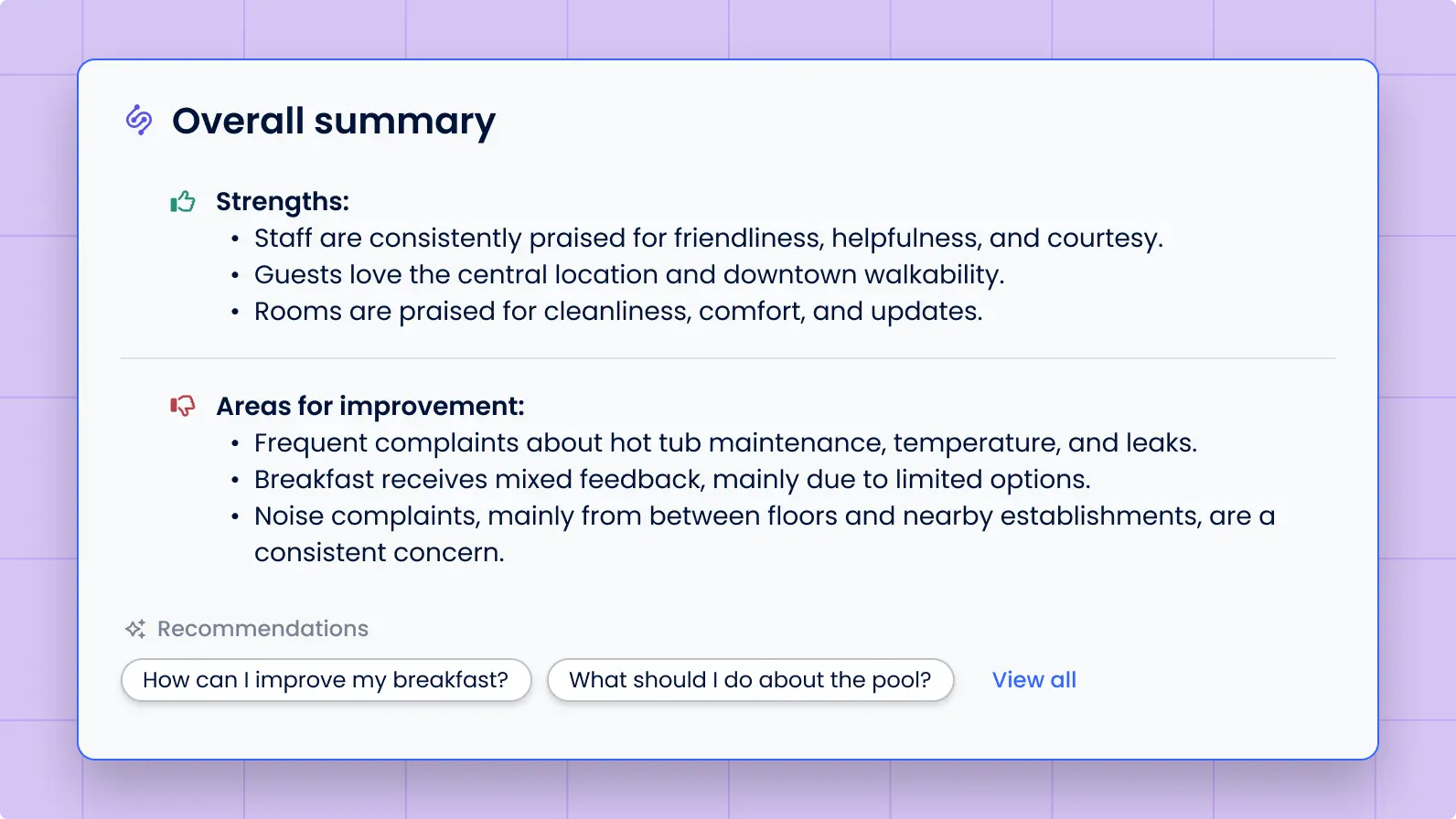
These insights are particularly valuable for larger hotels and multi-property groups looking to benchmark guest satisfaction across properties, prioritize operational improvements, and identify strengths worth highlighting in their marketing campaigns.
Email marketing and guest retention tools
Acquiring a new guest is generally more expensive than bringing back an existing one, making guest retention an important part of any hotel marketing strategy.
With access to guest preferences and reservation history, hotels can move beyond generic promotional emails and build more personalized campaigns that strengthen guest relationships, encourage repeat stays, and drive direct bookings.
| Tool type | What it does | Example tools |
| Hotel CRM and marketing automation tools | Build guest profiles, segment audiences, personalize campaigns, and automate communications | Cloudbeds Guest Marketing, Revinate, Cendyn |
| Email marketing platforms | Create, send, and measure email marketing campaigns | Mailchimp, HubSpot, Cloudbeds Guest Marketing |
| Loyalty management tools | Manage member benefits, rewards, and repeat booking incentives | Stash Hotel Rewards, StayRewards |
Hotel CRM and marketing automation tools
A hotel customer relationship management (CRM) system brings guest information, preferences, and reservation history together to support more personalized marketing.
Hotel-specific platforms like Cloudbeds Guest Marketing, Revinate, and Cendyn allow hotels to build audience segments based on criteria such as booking channel, stay frequency, travel dates, and past spending.
Marketing automation takes this further by triggering communications based on guest behavior or milestones, such as sending a personalized offer before the anniversary of a previous stay or encouraging a past OTA guest to book directly next time, where marketing permissions allow.
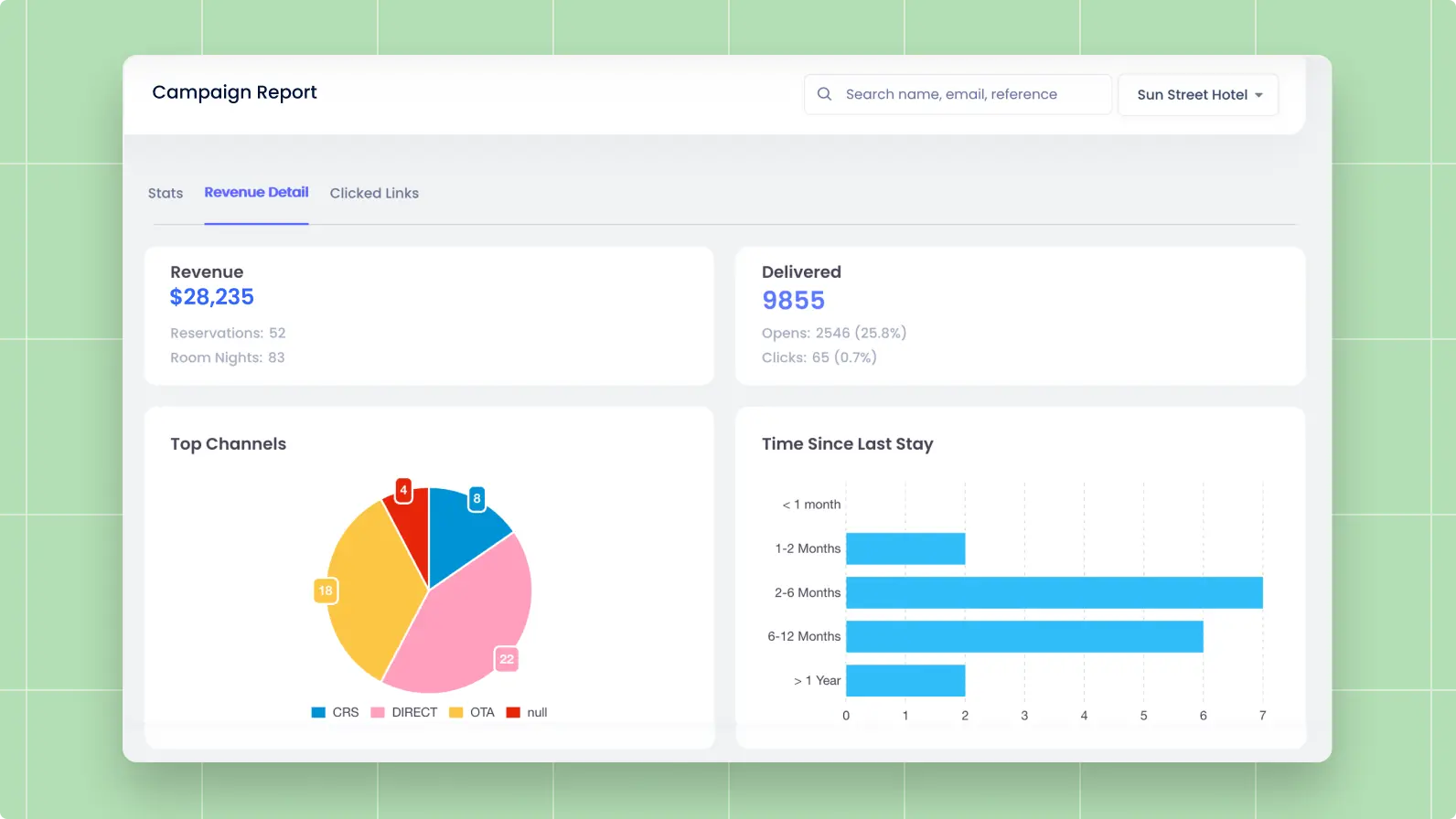
Look for tools that connect directly with your PMS and attribute campaign revenue to actual reservations, so you can measure success beyond open and click-through rates.
Email marketing platforms
Email marketing platforms like Mailchimp and HubSpot allow hotels to create branded newsletters, promote seasonal offers, automate email sequences, and track campaign performance.
Some hotel CRMs, like Cloudbeds Guest Marketing, have email marketing capabilities built in. This allows hotels to build and send targeted campaigns using the guest and reservation data they already have, without having to export contact lists or manage a separate email marketing platform.
Loyalty management tools
Loyalty programs aren’t exclusive to major hotel chains. Solutions like Stash Hotel Rewards and StayRewards help independent hotels offer rewards and incentives that encourage guest loyalty and repeat direct bookings.
Hotels don’t necessarily need a complex points-based loyalty program to encourage repeat stays. A returning-guest rate, exclusive promotional code, or complimentary room upgrade can give guests a compelling reason to book directly next time.
Hotels can manage simpler loyalty initiatives through their existing CRM and booking engine, while dedicated loyalty solutions can help properties build and scale more structured rewards programs.
Turn past guests into your best marketing channel.
Learn how to build, segment, and send campaigns that bring guests back direct.
Connect your hotel marketing efforts to revenue
Hotel marketing shouldn’t operate independently of the rest of your business. Your revenue strategy should inform your advertising campaigns, your reservation history should inform your email marketing, and your booking data should tell you which marketing investments are paying off.
Cloudbeds brings these capabilities together within a single hotel management platform. With Cloudbeds Digital Marketing, hotels can increase their visibility across paid channels, drive more direct bookings, and manage their online reputation, with customers seeing a 10x return on ad spend.
The opportunity doesn’t end once a guest books. Cloudbeds Guest Marketing uses guest and reservation data to deliver personalized campaigns that encourage repeat stays. Hotels using Guest Marketing see 40% more direct bookings on average, with repeat guests spending 67% more.
Because these tools are built on the same data foundation as the PMS, booking engine, and revenue management system, hotels can use the information they already have to make more informed marketing decisions and measure their impact on revenue.
Make room for better marketing tools.
See how Cloudbeds helps you attract new guests and keep them coming back.